Botanical Name: Zanthoxylum alatum Roxb.
Family: Rutaceae
Introduction:
Only Vagbhata quoted the synonym Tejini. Tejovati & tumburu names used by Acharyas.
Scientific classification: Prickly ash species belong to the rue family, Rutaceae. They constitute the genus Zanthoxylum. Northern prickly ash is classified as Zanthoxylum americanum, Southern prickly ash or Hercules’ club as Zanthoxylum claval-herculis, and lime prickly ash as Zanthoxylum fagara. The devil’s walking stick is classified as Aralia spinosa and belongs to the ginseng family, Araliaceae.
Names in different Indian languages
| English | Toothache tree, Indian Prickly Ash. |
|---|---|
| Hindi | Tumru, tejphal |
| Kannada | Tumburudu, dhiva |
| Malayalam | Tumpunal, tumpuni |
| Sanskrit | Tumburuh |
| Tamil | Tejyovathi, tumpunalu |
| Telugu | Gandhalu |
| Unani | Faaghir, Kabaab-e- Khandaan. |
| Folk | Nepaali Dhaniyaa |
Synonyms
Tumburu (fruit). Tejabala, Tejaswani, Tejohva, Tejovati (stem bark)
Zanthoxylum armatum DC.
Zanthoxylum planispinum Sieb. & Zucc.
Classification according to Charaka, Susrutha & Vagbhata
| Charaka | Sirovirecana, Katu skandha |
|---|---|
| Susrutha | |
| Vagbhata |
Varieties & adulterants – (CV – controversy, AD – adulterants)
1. Kãkamardanikã Cardiospetmum heliCacabum .
2. Zanthoxylum budrunga wall (Z. Rhetsa Dc)
3. Z. limonella (Dennst.) Alston and
4. Z. acanthopodium Dc
Morphology
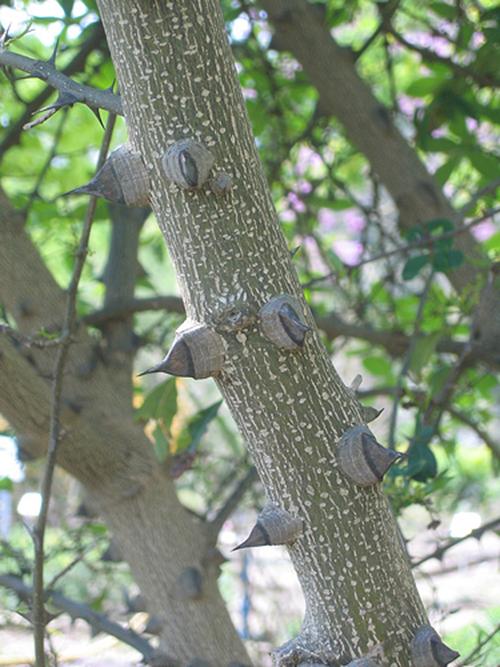
A small tree or shrub, with dense foliage and pungent, aromatic taste and smell; prickles often vertically flattened on the trunk and branches, the older with a cocky base.
Leaves- 4-15 cm, imparipinnate petiole glabrous narrowly winged, with two stipular prickler at the base; leaflets 2-6 pairs, lanceolate, glabrous beneath.
Flowers-in sparse panicles. Ripe carpels usually solitary, laxly panicled, broadly ovoid, pale red.
(Flowers in June-August and fruits in October-November)
Distribution & Habitat
hot valleys of sub-tropic Himalayas from Jammu to Assam and Khasi hills.
Chemical constituents:
Bark— berberine, xanthoplanine, magnoflorine
Fruits— arginine, histicline, thujene, xanthoxylene etc.
Root— spilanthol
Properties:
RASA- Katu, Tikta
GUNA– Laghu, Rüka, Tiksna
VIRYA– Usna
VIPAKA-katu
Karma – Kapha-vãta hara, Dipana–Pacana, sulaghna, kushtaghna, krimighna
Digestive, carminative, liver tonic, diuretic, constipating
Srotogamitva:
Dosha : kapha vata hara
Dhatu :rakta
Mala :mutrala
Organ : skin, intestine
Indication:
Hrdröga, Mukha roga, Dantaroga, Kantha roga, Agnimandya Aras, vasa-kãsa, Amavãta, Apatantraka, Udara.
cough, dyspnoea, hiccup, stomatitis, rheumatism, diabetes, ulcer, paralysis, skin disease, fever
Part used:
leaves. Flowers
Dosage:
Leaf juice 10-15 ml
Powder 1-2 g (fruit upto 3 gm.)
Decoction 50-100 ml
Internal uses:
External uses :
It is antiparasitic, stimulant and prevents necrosis. Its powder is used for dusting on wound. Local application is used in headache and heaviness of head. Juice is used for gargling in oral, dental and throat disorders.
Internal uses :
Nervous system : Vatahara and nervine stimulant, hence useful in vata disorders (paralysis and rheumatoid arthritis.)
Digestive system : Being an appetizer, digestive, .liver stimulant and anthelmintic. fruit is chewed and kept In mouth for brushing in dental diseases. Tejovha is used in anorexia, diarrhoea, liver and spleen enlargement and haemorrhoids.
Circulatory system : Because of tikshna, ushna and cardiac ‘stimulant properties, it is used in heart diseases
Respiratory system Useful in asthma and cough as it is kaphaghna.
Urinary system Being diuretic It is used in dysuria
Skin : Diaphoretic and cures skin disorders, hence useful in skindiseases
Therapeutic Uses:
(1) Mukha roga— Equal parts of Pãhã, Tejovti and Haritaki are powdered mixed with honey and chewed (C.S.Ci.26).
(2) Aras-Tumburu, Vianga, Devadãru and Yava are mixed with ghee and used for fumigation (C.S.Ci.26).