Botanical Name: Mangifera indica Linn.
Family: Anacardiaceae
Introduction:
Anacardiaceae (heart shaped).
Latin name : Mangifera -this name is derived from malayalam language; indica = Indian.
In the years 1556 to 1605, there was a garden having 1,00,000 Langada Mango trees in Bihar. This garden was namod as ‘Lakh Baug There are approximately 1000 varieties of mango fruit. Some of them are – Suvarnarekha Neelarn, Jahangeer, Phajane, Sulkhas, Jardatu, Himsaga Shahpasand, Rogani, Rajapuree, Vansharaj, AJfa,,zo rtrnandin, Totapuree, Mundappa, DashehariLangada, Zafaran, Rumanee etc. As the free ages, the number of fruits it bears also increase. There is the largest mango tree in Burelgaon at Arnbala district. Its stem has diameter of 9.75 mtrs. and its branches spread about 2258 square mtr: area. And every year this free bears about 170 quintnal fruits
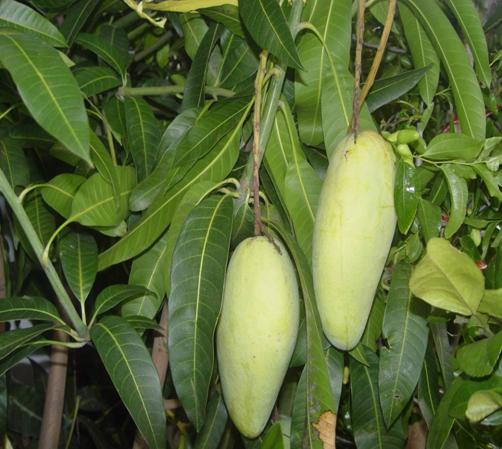
Names in different Indian languages
| English | Mango tree, spring tree, cupid’s favourite, cuckoo’s joy |
|---|---|
| Hindi | Aam |
| Kannada | Mavu |
| Malayalam | Mavu |
| Sanskrit | Amrah, chutah |
| Tamil | Mamaram, mankai |
| Telugu | Mamidi |
| Unani | Aam, Ambaj |
| Folk |
Synonyms
In Sanskrit, mango has 63 names. Some of them are as follows
Aamra, Amb, Rasaal, Sahakaar, Pikavallabha, Madhudoot, Atisaurabha, Maakanda, Kamashar, Madhavdruma, Bhrungubheeshta Seedhurasa, Vasantdoota, Atisaurabha, Madirasav, Kokilabandhuk Shukapriya
Classification according to Charaka, Susrutha & Vagbhata
| Charaka | |
|---|---|
| Susrutha | |
| Vagbhata |
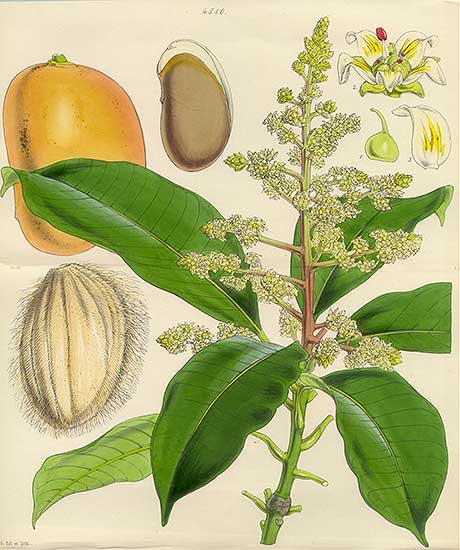
Varieties & adulterants – (CV – controversy, AD – adulterants)
Morphology
A very big tree having height of 10 to 12 mtrs. giving much shade.
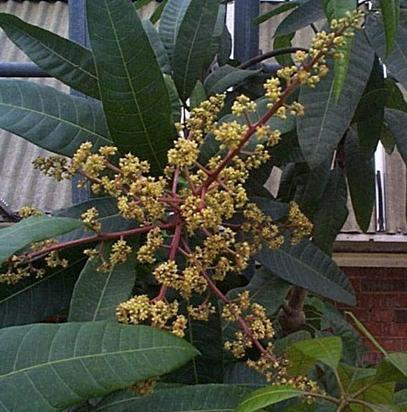
Leaves -12 to 16 cms. long , simple, lanceolate, bunchletes, and are used in sacred functions. It has a distinct inflorescence which is fragrant.
Flowering seasons spring and fruits occur in summer. (In India, mago has been known for 4000 year. In Ramayana and Mahabbarata mango is described.)
Distribution & Habitat
Tropical regions of India
Chemical constituents:
Sugars, citric acid, ascorbic acid , beta-carotene ,m-digallic acid, gallotannin, phloroglucinol, protocatechuic acid, flavonoids ,tetrahydroxy benzene, kaempferol, myricetin
Properties:
Mango has different properties according to its stages. Bark. leaves, flowers and seeds are kapha pittashamak. haemostatic and wound healing. Ripe mango is vatapittashamak. Raw fruit is tridoshakarak.
Raw mango – appetizer, improves digestion and vitiates rakia pitta. Panha (sherbet) reduces burning,
Leaves – antiemetic. In pyuria leaf juice is useful.
flowers – astringent, antidiarrhoeal.
Bark- astringent heals the wounds and reduces inflammation of uterus.
Seed – anthelmintic reduces inflammation of uterus. antidiuretic, constipative and useful in menorrhagia and leucorrhoea.
Ripe mango – unctuous. laxative. cardiotonic. haemostatic. aphrodisiac, gives strength and improves complexion.
Pushpam
RASA-amla
GUNA–guru
VIRYA-sheeta
VIPAKA-amla
Karma – agnidepakam, ruchyam, kaphaghnam, pitta vardanam
Indication:
Pradara, atisara
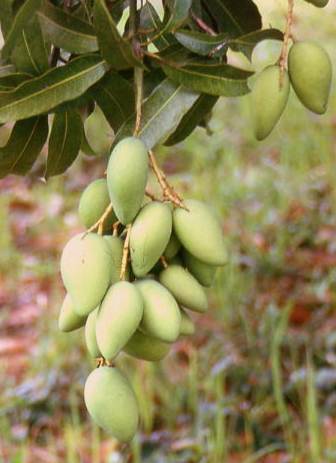
Amram ( apakvam) – small
RASA-tikta, amla
GUNA-laghu
VIRYA-ushna
VIPAKA-katu
Karma –vatapitta vardanam, grahi, rakta dosha samana
Amra (Apakva)
RASA-amla
GUNA–guru
VIRYA-ushna
VIPAKA-amla
Karma –vata hara, laxative
Amra (pakva)
RASA-madhura
GUNA–guru
VIRYA-sheeta
VIPAKA-madhur
Karma – vrishya, hridya, atisaraghna, sukla vardana, vata nashanam,
Seed kernal
RASA- Madura, amla, kashaya
GUNA–guru
VIRYA-sheeta
VIPAKA-madura
Karma –grahi, trishna nasana, daha nashana, rakta– pitta – jwara –ghna
Root
Karma –
Grahi, sheeta, ruchyam, kapha vataghnam, yoniroga haram
coomon
Karma –
carminative, digestive,astingent, bitter, aphrodisiac, decreases lipid cholesterol level, blood purifier, antipyretic,
antimicrobial, antifungal, anthelmintic, antiviral, anti-inflammatory, antifertility, hypoglycaemic
Srotogamitva:
Dosha : Raw fruit – tridosh prakopak, ripe frutt– vata pitta shamak.
Dhatu : Bark, leaves; flowers and seed . raktagami (haernostatic): mansagami (wound heating). Raw fruit- rakta pitta prakopak; seeds rakta (stops menorrhagia): ripe fruit – raktagami (haemostatic), shukra – aphrodisiac, mansa meda (brimhana,. rakta improves complexion), rejuvenation.
Mala :Mutragami (leafjuice –pyruia), seed (antidiuretic, purisha (antidiarrhoeal, seed-anthelmintic).
Organs : Intestine, uterus
Indication:
fever, skin disease, cough, piles, leucorrhoea,vomiting, dysentery, gout, burning sensation, dyspepsia, cephalgia, worm infection
Part used:
Bark, fruit, leaves, seed
Dosage:
Leaf juice 10-15 ml
Powder 2-4 g
Decoction 50-100 ml
Important Yogas or Formations:
Amra palavadi lehya