Botanical Name: Solanum xanthocarpum S. &W.
Family: Solanaceae.
Introduction:
Nightshades make up the genus Solanum, and the family Solanaceae, in the order Solanales. Horse nettle is classified as Solanum carolinense, European bittersweet as Solanum dulcamara, silverleaf nightshade as Solanum elaeagnifolium, and black nightshade as Solanum nigrum. Buffalo bur is classified as Solanum rostratum, the common potato as Solanum tuberosum, the eggplant as Solanum melongena, and the Jerusalem cherry as Solanum pseudocapsicum. The sweet potato, classified as Ipomoea batatas, and the morning glory, classified as Ipomoea purpurea, belong to the family Convolvulaceae. Jacob’s ladder, classified in the genus Polemonium, and the common annual phlox, classified as Phlox drummondii, belong to the family Polemoniaceae.
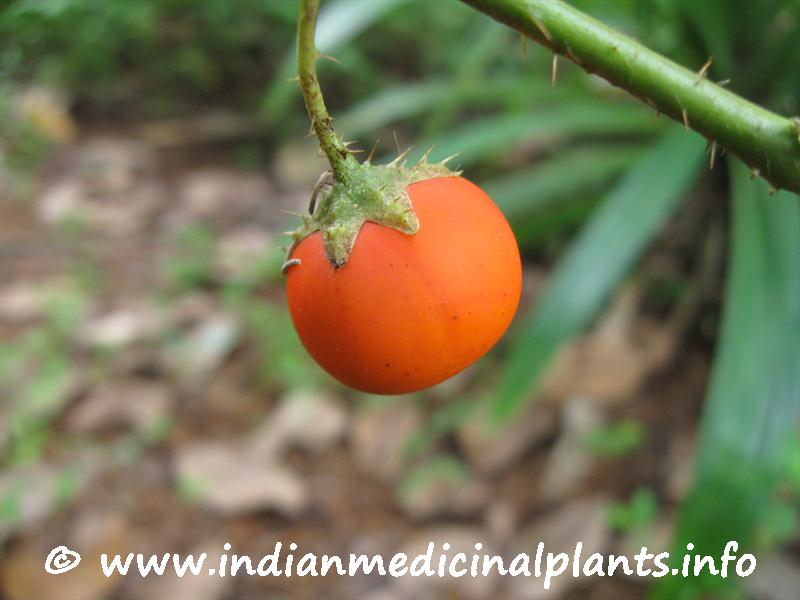
Names in different Indian languages
| English | Yellow berried nightshade |
|---|---|
| Hindi | Remgani, kateli, kattay |
| Kannada | nelagulle |
| Malayalam | Kantakari, kantakattiri |
| Sanskrit | Kantakari, nidigdhika |
| Tamil | kantakatrri |
| Telugu | Nelamulaka, callamulaga |
| Unani | Kataai Khurd, Hadaq |
| Folk |
Synonyms
Kantakaari, Kantakaarikaa, Vyaaghri, Nidigdhikaa, Nidigdhaa, Duhsparshaa, Dhaavani, Kshudraa, Keteri (Smallar var.), Bhatakataiyaa. Used as Lakshmanaa.
Solanum surattense Burm.f.
Solanum virginianum Linn.
Solanum maccanni Sant.
Classification according to Charaka, Susrutha & Vagbhata
| Charaka | Kãsahara, srothahara, Hikkanigrahana, Kanthya, Angamardaprasamana |
|---|---|
| Susrutha | Brhatyädi, Varunãdi, Laghupancamüla |
| Vagbhata | Brhatyädi, Varunãdi |
Varieties & adulterants – (CV – controversy, AD – adulterants)
1. S. indicum;
2. S. trilobatum
3. S. tuberosum Linn- [AD]
4. S. pittospoorifolium – [AD]
S. trilobatum
Morphology
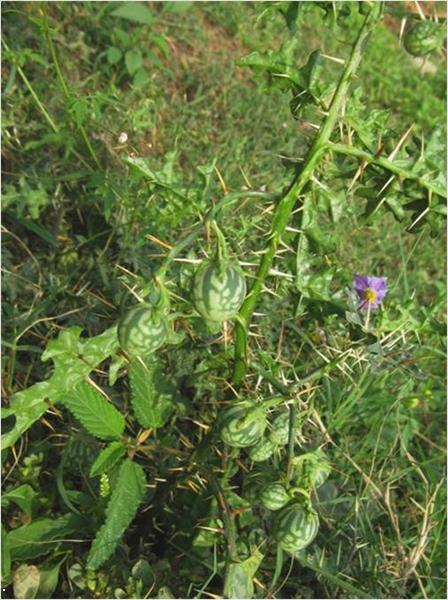
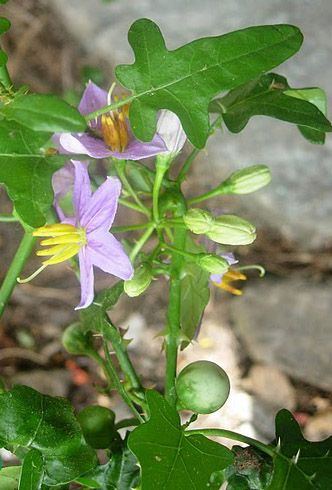
A prickly, diffuse perennial undersherb, woody at base, with zig zag branches.
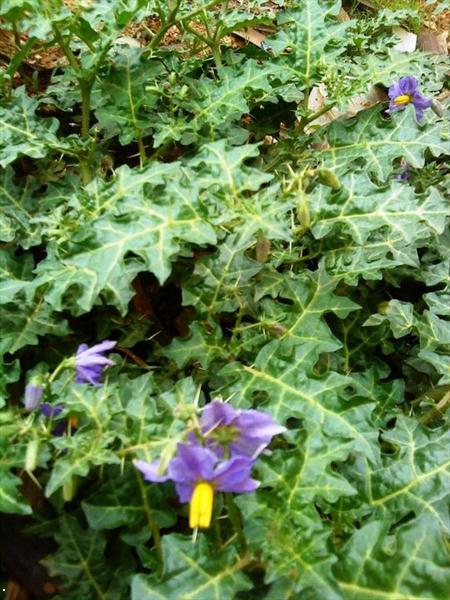
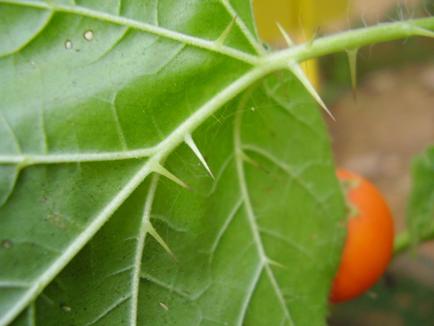
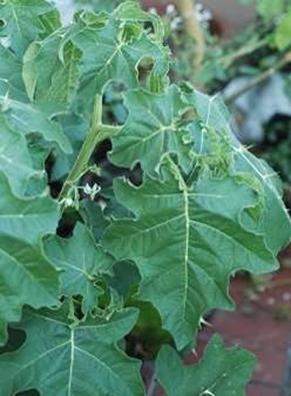
Leaves— ovate or elliptic sinuate or subpinnatified glabrescent, with straight spines, armed on midrib and the nerves with long yellow sharp prickles.
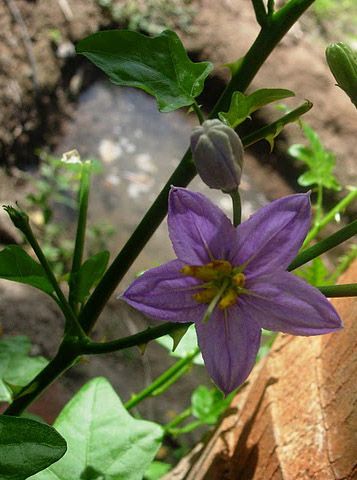
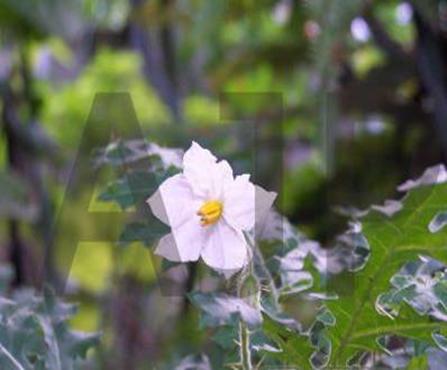
Flowers— in few flowered lateral cymes. blue-coloured; corolla with shallow lobes.
Fruit— globose berries, glabrous., whitish and green-blotched, yellow when ripe.
Seeds— many, glabrous.
Flowers and fruits from Match-July
Distribution & Habitat
Common in waste lands and road-sides throughout
India.
Chemical constituents:
solasonine, solamargine, beta-solamargine and solasodine,
apigenin, quercetin diglycoside and sitosterol
Properties:
Rasa Katu, Tikta
Guna Laghu, Rüksa, Tiksna
Virya Usna
Vipaka Katu
Karma : Kapha-vata hara, Dipanapacana, Mutrala, Asmarighna, Sukra recaka
Stimulant, expectorant, diuretic, laxative, febrifuge, Anti inflammatory, digestive, carminative, promoting conception
Srotogamitva:
Dosha : Pittavardhak, reduces kapha and vats.
Dhatu : Shukra (fruit increases mobility of sperms and ejaculation). meda (hans), garbha karini.
Mala : Purisha (purgative), bhedan (in renal calculi and dysuria), diaphoretic.
Organs : Lungs (cough, whooping cough).
Indication:
Kãsa, Svãsa, sotha, Hikkã, Mütrakrcchra, Asmari, Pratisyãya
cough, bronchitis, asthma, rheumatism, enlargement of liver and spleen, vomiting, difficult urination, bladder stones, skin diseases
Part used:
Whole plant
Dosage:
Leaf juice 10-15 ml
Powder 2-4 g
Decoction 50-100 ml
External use : It is analgesic. anti-inflammatory and has antibacterial properties. Therefore its fumes are inhaled in dental caries, dental pain and piles. (It is said that this type of fumigation with kantakari destroys the bacteria in teeth).
Internal use:
Nervous system : It is used a neurolocal disorders like epilepsy and convulsions as a stimulant due to its irritant property The juice droplets are put in nose, which helps in stimulating nerves (Sangnya prabodhana) It pacifies vata due to ushna guna Its local application helps in bodyache and arthritis.
Digestive system : Being katu, tikta and ushna, it can be used as an appetizer and carminative, it helps in purgation and in dewormification. It is used in loss of appetite, constipation . powder of seeds is used in dental aches
Circulatory system : It is cardio-stimulant, blood purifier and anti-inflammatory. Therefore is used in cardiac disorders, skin disorders, blood disorders and inflammation.
Respiratory system :kantakari is the drug of choice on cough. It helps in vata type of cough. It helps as an expectorant and demulcent. It stops hiccups and also helps in asthma, chronic rhinitis. cough, pneumonia, hoarseness of voice and hiccups. Powdered S. xanthocarpum with honey is given to children in chronic bronchitis.
Urinary system : Its diuretic property helps in renal calculi and dysurea.
Reproductive system : The seeds are oxytoxic and aphrodisiac. The root of white flowered ringni is used in punsavan vidhi
Skin: Being ushna (hot) in nature, it Increases perspiration. It is useful in many skin disorders
Important Yogas or Formations:
Nidigdhtkadi kadha, Vyaghri haritaki, Kantakari ghrita. vyaghri oil. S. xanthocarpum is one of the constituents of laghu panchamool and -dashamool. The plants in taghupanchmool are small. This plant is included is dashmool, which is a dass of antipyrtic and anti-inflammatory plants. This itself snows the importance of the plant, Kañakãri grihta, Vãsã kantkäri Aveleha Vyaghri Haritaki, Vyaghri taila.
Therapeutic Uses:
(1) Svãsa—Kantkãri, Amalaki (each 1 part) and Hingu (1/2 part) are taken with honey cures Svãsa roga in three days (S.S.Ut. 51).
(2) Kasa— Decoction of Kantakãri given with Pippali will be useful (C.D.) & (V.M.).
(3) Pumsavana— White Brahati root is pounced with milk and used as nasal drops (A.H.Sa. 1/40).
Descriptions on Ayurveda books / Nighandu:
1
2
3
4
5
6
7
8
9
10
11
12