Botanical Name: Solanum nigrum Linn.
Family: Solanaceae
Introduction:
Latin name : Solanum = comforting, having sedative qualites; nigrum = niger – black.
Nightshades make up the genus Solanum, and the family Solanaceae, in the order Solanales. Horse nettle is classified as Solanum carolinense, European bittersweet as Solanum dulcamara,silverleaf nightshade as Solanum elaeagnifolium, and black nightshade as Solanum nigrum. Buffalo bur is classified as Solanum rostratum, the common potato as Solanum tuberosum, the eggplant as Solanum melongena, and the Jerusalem cherry as Solanum pseudocapsicum. The sweet potato, classified as Ipomoea batatas, and the morning glory, classified as Ipomoea purpurea, belong to the family Convolvulaceae. Jacob’s ladder, classified in the genus Polemonium, and the common annual phlox, classified as Phlox drummondii, belong to the family Polemoniaceae.
Names in different Indian languages
| English | Black Nightshade |
|---|---|
| Hindi | Mako, gurkkamai |
| Kannada | Kakarundi |
| Malayalam | Manattakkali, karintakali, karintakkali |
| Sanskrit | Kaakamaachi |
| Tamil | Manittakkali |
| Telugu | Kamanci, kacci, kaccipandu, gajjucettu |
| Unani | |
| Folk |
Synonyms
Kaakaahya, Kaakamaataa, Dhvankshamaachi
Solanum rubrum Mill.
Classification according to Charaka, Susrutha & Vagbhata
| Charaka | |
|---|---|
| Susrutha | |
| Vagbhata |
Varieties & adulterants – (CV – controversy, AD – adulterants)
Morphology
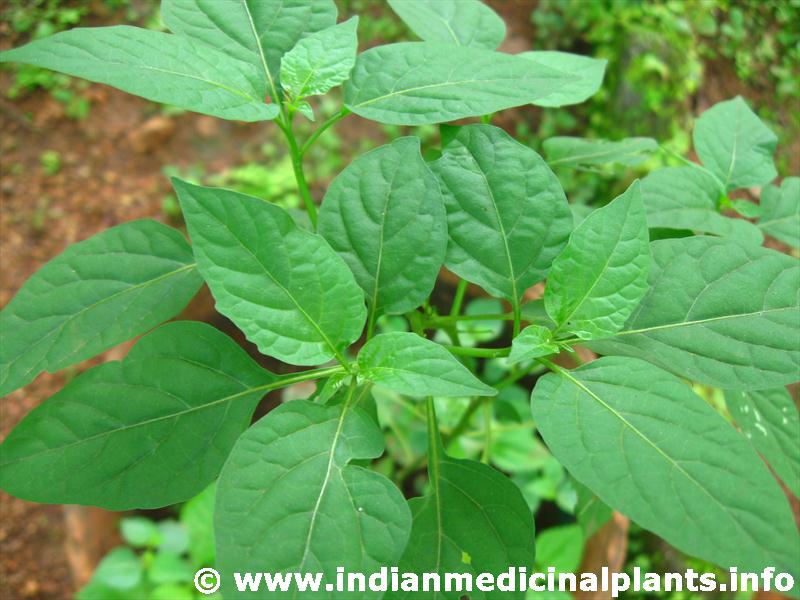
This is a shrub with irregular branches and grows upto a height of 30 cm. to 1 mt.
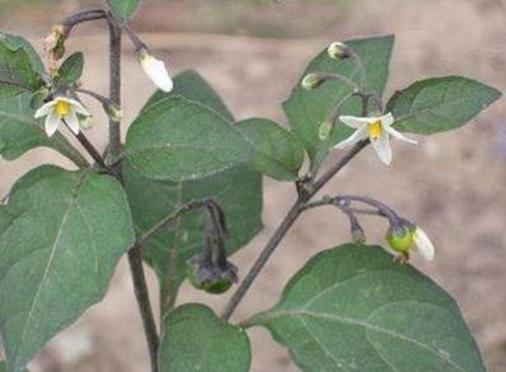
Leaves- simple, alternate, glabrous, 5cm. to 7cm. in length and 2.5cm to 3.75cm in breadth.
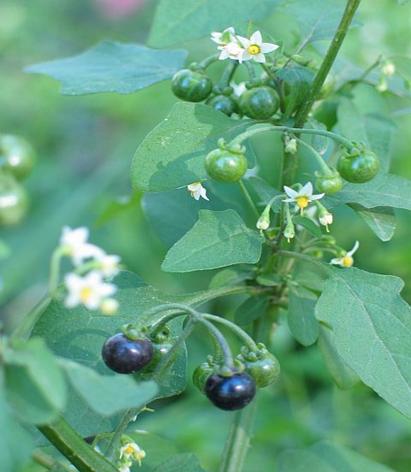
Flowers – small and white, cyme
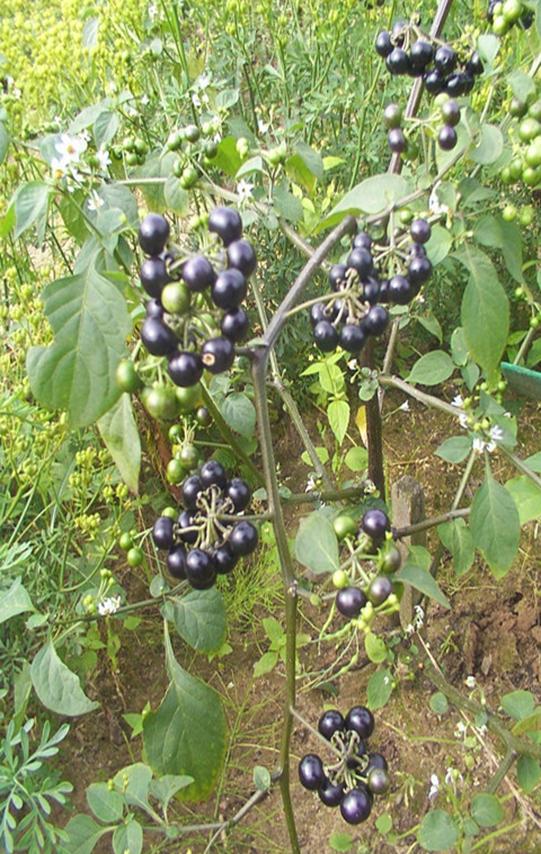
Fruits – berry, small, spiral. smooth. green when unripe but turn blue on ripening, in bunches. The plant flowers in rainy season an fruits in spring.
Distribution & Habitat
All over India
Chemical constituents:
solasonine, alphaand beta-solanigrine, alpha-and betasolamargine; steroidal sapogenins, diosgenin and tigogenin; solasodine and solasodine.
Properties:
RASA-kashaya
GUNA– laghu, snigdha
VIRYA-anushna
VIPAKA-katu
Karma – hridya, dipana, pachana, vrisyam, rasayana, virechana
anti-inflammatory, antispasmodic, sedative, diuretic, laxative, antiseptic, expectorant
Srotogamitva:
Dosha : Tridoshaghna.
Dhatu : Shukra (brimhana) rasayana (nourishes all the seven dhatus), rasa (fever), meda (antidiabetic),rakta (dermatoses).
Mala : Purisha (purgative).
Indication:
Kasa, swasa, krimi, kusta, vrana
Part used:
Whole plant
Dosage:
Leaf juice 10-15 ml
Powder 2-4 g
Decoction 50-100 ml
Precaution : Large dose causes vomiting, diarrhoea, thirst, abdominal colic, headache, delirium, seizures, coma and sometimes even death.
Antidote : The treatment should be done similar to dhatura poisoning.
Uses : It is used extensively in inflammation, osteoarthritis, wounds.. liver enlargement and ascites. Its decoction is used for gargling in stomatitis, throat infection and tonsillitis. Warm decoctions used locally in earache. Its juice is used for nasal administration in nasopharyngeal diseases and ineye disorders. Being a digestive, it is used in loss of appetite, common cold, liver diseases, piles,ascites, dysentery, splenomegaly, heart disease and oedema (used as a vegetable). The powder of the fruit is used in hoarseness of voice, cough and asthma. It can also be useful in renal disorders, gonorrhoea, dysuria, skin disorders and chronic fever.
Therapeutic Uses:
- Leaf juice with honey useful in cough.
Descriptions on Ayurveda books / Nighandu:
1
2
3
4
5
6
7
8
9
10
11
12