Botanical Name: Sapindus laurifolius Vahl.
Family: Sapindaceae
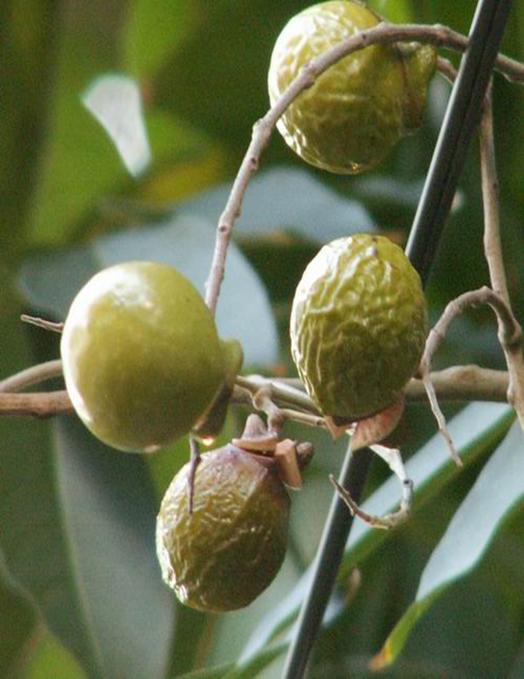
Introduction:
Sapindaceae (a group from which soap is derived).
Latin name : Sapindus = which yields soap; trifoliate = having three leaves,
Soapberry, common name for a medium-size family of mostly woody flowering plants widely distributed in tropical areas, and for its representative genus.
The soapberry family includes important tropical timber, such as akee, native to West Africa. This species has been introduced in the West Indies, where the ripe fruit is fried and eaten with fish (the unripe fruit is highly toxic). Several tropical fruits, such as the litchi, are members of the soapberry family. The representative genus contains about 13 species; 2 occur in the United States, and the fruits of both are poisonous.
Flowers of the order to which the soapberry family belongs are characteristically functionally unisexual, small, and insect pollinated. The order contains about 5400 species placed in 15 families; the two largest are the rue family, with about 1700 species, and the soapberry
Names in different Indian languages
| English | Soapnut tree of South India. |
|---|---|
| Hindi | Reethaa |
| Kannada | Kugatemara, antawala |
| Malayalam | Urunci, uruvanchi |
| Sanskrit | Arishtaka, phenilah |
| Tamil | Puvamkottai, Mani pungu. |
| Telugu | Kunkutikaya, kumkuticettu, phenilamu |
| Unani | Reethaa |
| Folk |
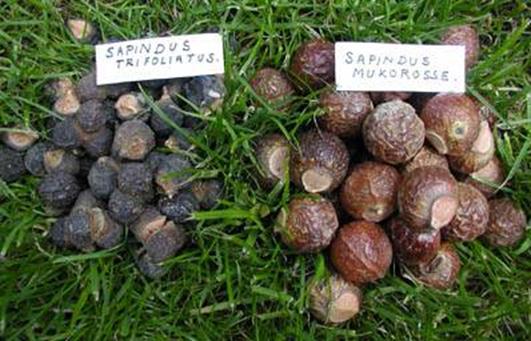
Synonyms
Arishtaka, Phenila, Raktabeeja, Reethaakaranja, Garbhapaatana.
Sapindus trifoliatus auct. non Linn.
Classification according to Charaka, Susrutha & Vagbhata
| Charaka | |
|---|---|
| Susrutha | |
| Vagbhata |
Varieties & adulterants – (CV – controversy, AD – adulterants)
Morphology
This tree is 8 to 10 mtrs. high and has many branches with leaves and leaflets- 2, 3 pair-oblong-lanceolate,
Flowers are white. Fruits are round, t occur in spring.
Distribution & Habitat
Throughout India
Chemical constituents:
Saponin , genins, methylhedragenate, sapindic acid ,methyl oleanolate
Properties:
Guns: laghu, snigdha, tikshna;
Rasa : katu, tikta;
Vipaka katu;
Veerya: ushna;
Prabhav : vamak (emetic);
Karma –
Garba padi, vamanakam, lekhana
astringent, emetic, detergent, anthelmintic
Srotogamitva:
Dosha Tridoshaghna, kaphapittashodhan.
Dhatu Rasa (induces emesis); rakta (cures dermatoses); meda(lekhan).
Mala : Kaphashodhan (mob of rasa dhatu).
Organs: Uterus (induces abortion) oxytropic (in the form of nasya in migraine)
Indication:
Kushta, kandu, visha
migraine, epilepsy , hysteria, gout, rheumatism and paralysis
Part used:
Whole plant
Dosage:
Leaf juice 10-15 ml
Powder 2-4 g
Decoction 50-100 ml
uses:
External use : Anti-inflammatory.
Internal uses : It purifies vitiated kapha and pittá by emetic and purgative actions whereas alleviates vata by snigdha and ushna properties. Seed is intoxicant, while fruit rind has oxytropic action. In migraine, its water or powder is used as a nasya. In morphine poisoning, it is given orally to induce emesis.