Botanical Name: Pistacia integerrima Stewart ex Brandis.
Family: Anacardiaceae
Introduction:
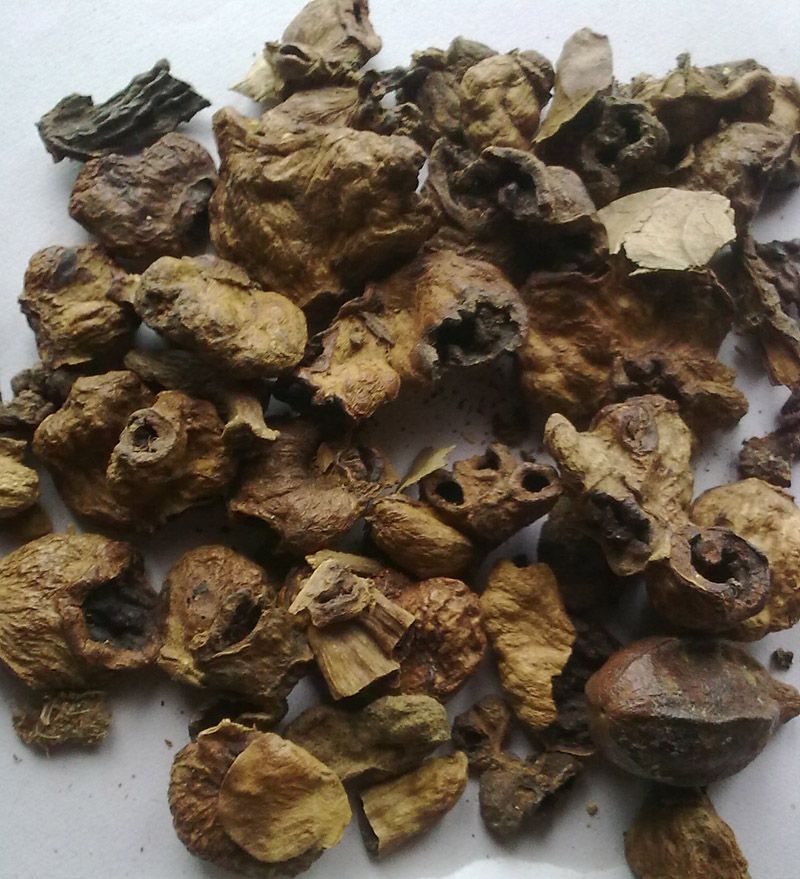
Karkada is the name of the tree producing srngi (gall). People consider this tree as dreadful. It is important to note that Susruta classified it as poisonous tuber. Gall produced on the leaves. Gall produced by the help of a insect- Dasia aedifactor – (plant produce resin against insect). Mainly effective in children’s diseases.
Scientific classification: Pistachios make up the genus Pistacia of the family Anacardiaceae. The pistachio, or pistacia, tree is classified as Pistacia vera, Pistacia integerrima, and the turpentine tree as Pistacia terebinthus.
Names in different Indian languages
| English | |
|---|---|
| Hindi | Karkatasringi |
| Kannada | Karkatasringi |
| Malayalam | Karkatasringi |
| Sanskrit | Karkatasringi, karkata |
| Tamil | Karkatasringi |
| Telugu | Karkatasringi |
| Unani | Karkatasringi, Kakar |
| Folk |
Synonyms
Karkatashringi, Shringi, Karkatashringikaa, Karkata, Karkataakhya, Kulirashringaaya, Kuliravishaanikaa, Vakraa, Vishaani. Ajashringi
Pistacia chinensis Bunge subspecies Integerrima (Stewart) Rech. f.
Classification according to Charaka, Susrutha & Vagbhata
| Charaka | Kãsahara, Hikkanigrahana, Madhura skañdha |
|---|---|
| Susrutha | Kakolyãdi, Padmakãdi |
| Vagbhata |
Varieties & adulterants – (CV – controversy, AD – adulterants)
1. Pistacia chinensis (synonym )
2. Rhzus succedanea Linn( commercial)
3. Ajasrngi ,Mesasrngi, Uttamãsrngi ( controversial- creeper)
4. Karkatika
5. Karktahvaya
6. Karkatãkhya
7. Pistacia lentiscus – Mastic tree.
Rhzus succedanea
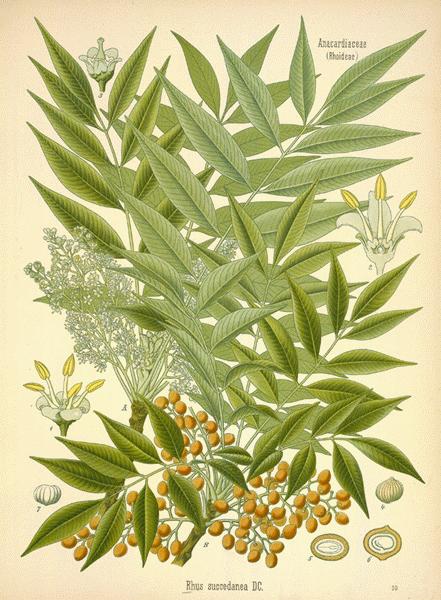
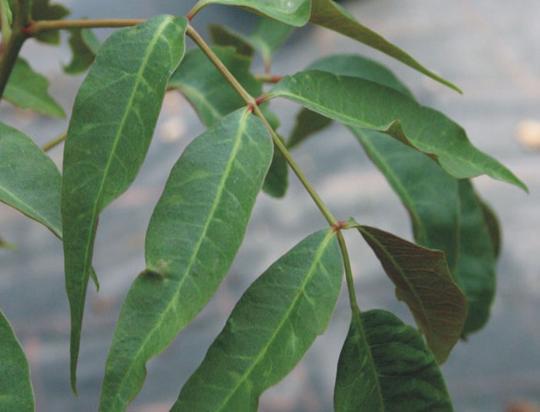
Morphology
It is glabrous tree grown unto 18 m, dark grey or blackish bark.
Leaves: 20-25 cm long, with or without terminal leaflet; leaflets 4-5 pairs, lanceolate, coriacious, base oblique.
Flowers: Small reddish in lateral panicles; male compact, pubescent; female elongate.
Fruit: Drupe, globose, Grey on ripe. dry, stony, , glabrous, rugose,
Seeds: with a membranous testa. (Flowers and fruits during March-April).
Distribution & Habitat
North-west Himalayas at 400- 2000 m; cultivated in Punjab plains.
Chemical composition
Pistacigerrimones A, B and C
It has 60% tanin and volatile oil,maiphal , tannins.
Galls— essential oils, resin, pistacienoic acids A & B, Beta — sitosterol, aromadendrene, camphene, caprylic acid, cineol, a— pinene, Alpha-pinene, beta-pinene,alpha-phellandrene and delta-carene etc.
Leaves & bark— tannins.
Seeds—amino acids, dihydromalvic acid, proteins etc.
Seeds—sterals, triterpenoids etc.
Drupe-oil— pistacin, pistacinin, dihydroquercetin etc.
Properties—
Rasa: Kasäya, Tikta
Guna: Laghu, Ruksa
Virya: Usna
Vipãka: Katu
Karma: Kapha-vatahara, vrsya, Grãhi, Dipana
Anti inflammatory , digestive, depurative, constipative, astringent, expectorant, antiasthmatic, antidysenteric, styptic
Indications— Jvara, Kãsa-Svãsa, Hikkã, Trsnã, Chardi, Aruci, Bãla roga
anorexia, fever, leucorrhea, general debility, Bronchitis and dyspnoea
Srotogamitva
Dosha: Kaphaghna. vatashamak.
Dhatu:Rasayani – rasa (fever).
Mala: Purisha – constipative.
Srotas : Respiratory system – (dyspnoea and cough – specially in children). Uterus (endometrial).
Part Used— Galls.
Dosage— Powder 4-5 g
External use : It is applied on swelling (edema). In pyorrhoea, gargles of decoction is useful, Fowler’s applied on both fresh and chronic wounds
Internal use
Digestive system it is an appetizer. carminative and astringent in nature, thus useful and effective in anorexia, diarrhoea, dysentery.
Respiratory system Because of its bitter and pungent taste it is an expectorant. Helps in hiccoughs. cough and dyspnoea. It strengthens the respiratory membrane inner lining of the surface.
Reproductive system It reduces uterine exudates: thus helps in healing.
Temperature it is used in fever induced by vata and kapha.
Satmikaran Being bitter and hot, it is a bitter tonic rasayan. Useful as rasayan in tuberculosis.
Important Yogas or Formations
Shningyadi churna. Karkatadi churna, Bala chaturbhadra churna, Balasanjivoni churna.
Important research work going on
1. CNS depressant activity
2. Anti inflammatory activity
Therapeutic Uses—
(1) Vãjikarana— Karkatasrngi Kalka should be taken with milk while consuming sugar, ghee and milk as the main diet (A.S.Ut.50).
(2) Vãtaja Kasa—Karkatasrngi powder is given with oil as Anupãna (C.S.Ci. 18).
(3) Kãsa— Karkatasrngi powder may be licked with ghee, sugar and honey followed by milk as Anupana (A.S.Ci.4).