Botanical Name: Kalanchoe pinnata (Lam.) Pers.
Family: Crassulaceae
Introduction:
Crassulaceae (plants of the crassula tribe, the leaves are fleshy and succulent).
Latin name: Kalanchoe = from the Chinese name of one the species: pinneta = feathered.
Sanskrit name Parnabeej, not in use till the period of Vagbhatta.
Scientific classification: Kalanchoes belong to the crassula family, Crassulaceae, which also includes the succulent jade plant. Blossfeld’s kalanchoe is classified as Kalanchoe blossfeldiana, panda plant asKalanchoe tomentosaI, and feltbush as Kalanchoe beharensis.
Names in different Indian languages
| English | |
|---|---|
| Hindi | Jakh me hayat |
| Kannada | Gandukalinga |
| Malayalam | Ilamulachi, ilayinmeltai |
| Sanskrit | Parnabijah |
| Tamil | Runakalli, malakkali |
| Telugu | Simajamudu |
| Unani | Zakhm-e-Hayaa |
| Folk |
Synonyms
Parnabija, Pattharchuur, Pattharchat, Hemsaagar
Bryophyllum pinnatum (Lam.) Oken.
Bryophyllum calycinum Salisb
Classification according to Charaka, Susrutha & Vagbhata
| Charaka | |
|---|---|
| Susrutha | |
| Vagbhata |
Varieties & adulterants – (CV – controversy, AD – adulterants)
Morphology
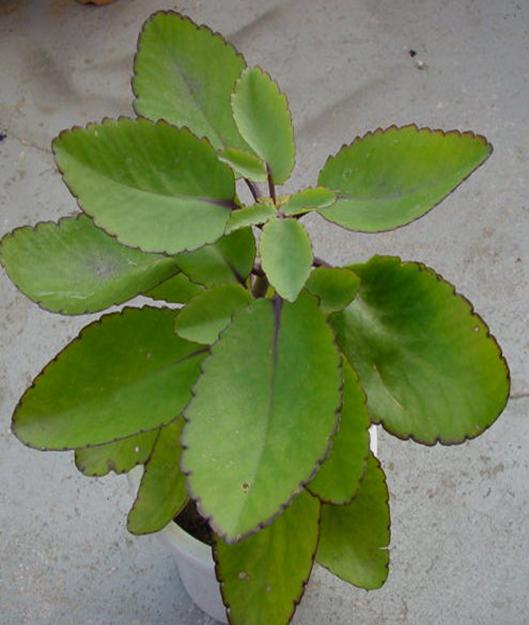
The height of the plant is 30cm to 1 mrts. It is also known as panphuti, dhanvantari, etc. It contains three leaflets which are 10-20 cm. long and fleshy, oval, with serrated margins.
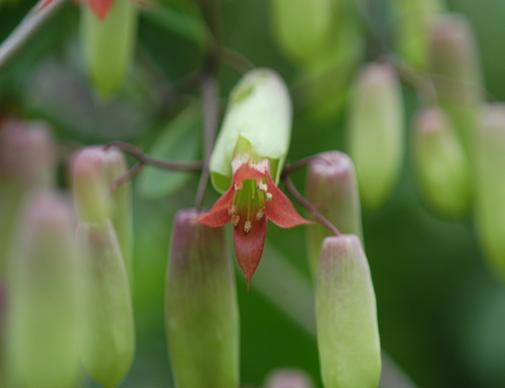
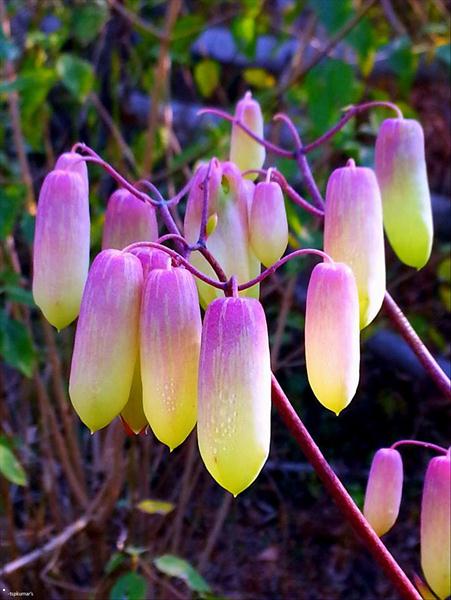
Flowers – 2 inches long, red coloured.
Legume – divided into four parts, contains plenty of seeds. Serrated margin bears reproductive capacity and can give rise to a new plant so it is called parnabeej. Large variety of parnabeej in Bengal is called himsagar.
Distribution & Habitat
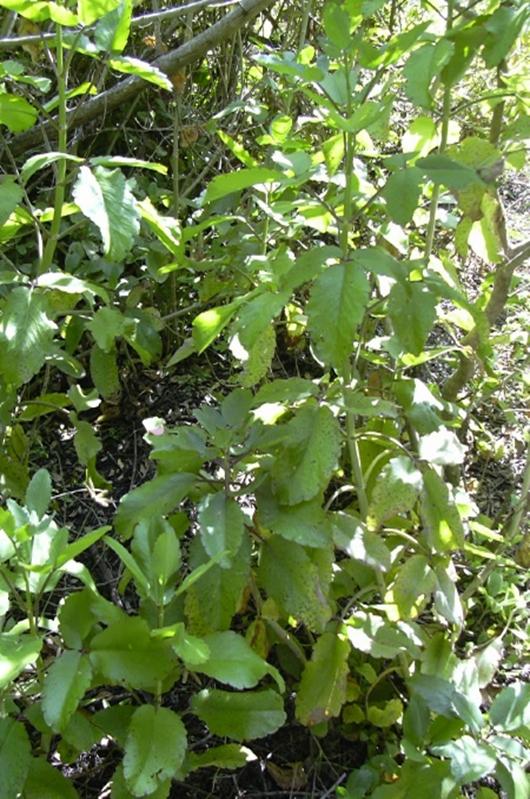
Throughout India
Chemical constituents:
quercetin, kaempferol, quercetin-3-diarabinoside,kaempferol-4-glucoside, n-hentriacontane, n-tritriacontane, alpha- and beta-amyrin, sitosterol
Properties:
Guna: laghu, ruksha;
Rasa: kashaya, amla;
Vipaka: madhur;
Virya: sheeta;
Karma –
anti-inflammatory, antifungal, antibacterial.
Srotogamitva:
Dosha: Vataghna, pittaghna.
Dhatu: Rakta, mansa. . –
Mala: Purisha (dysentery). .
Dhatu: Rasa, rakta.
Mala: Purisha (cholera), rnutra (calculi).
Indication:
wounds, burns, boils, swellings
Part used:
Whole plant
Mainly external application
Dosage:
Leaf juice 3-6 ml
Powder 2-4 g
Decoction 50-100 ml
Uses: Externally, it is used in bleeding wounds for hemostasis and healing.
internally the juice of the leaves in a dose of 3 to 6 ml. is given in dysentery, bleeding piles and menorrhagia.