Botanical Name: Juglans regia Linn
Family: Juglandaceae
Introduction:
Latin name Juglans = walnut free; regia = royal.
Scientific classification: Walnuts make up the family Juglandaceae in the order Juglandales. The English, or Persian, walnut is classified asJuglans regia and the black walnut as Juglans nigra. Butternuts are classified in the genus Juglans, pecans and hickories in the genusCarya. The family Rhoipteleaceae belongs to the order Juglandales and contains the single species classified as Rhoiptelea chiliantha.
Names in different Indian languages
| English | Walnut tree |
|---|---|
| Hindi | Akhor , akhrot |
| Kannada | Akhrodu |
| Malayalam | akhrottu |
| Sanskrit | Akshodaka |
| Tamil | akhrottu |
| Telugu | akhrotu |
| Unani | Akhrot |
| Folk |
Synonyms
Akshoda, Akshodaka, Akshota, Shailbhava, Pilu, Karparaal, Vrantphala
Classification according to Charaka, Susrutha & Vagbhata
| Charaka | |
|---|---|
| Susrutha | |
| Vagbhata |
Varieties & adulterants – (CV – controversy, AD – adulterants)
Morphology
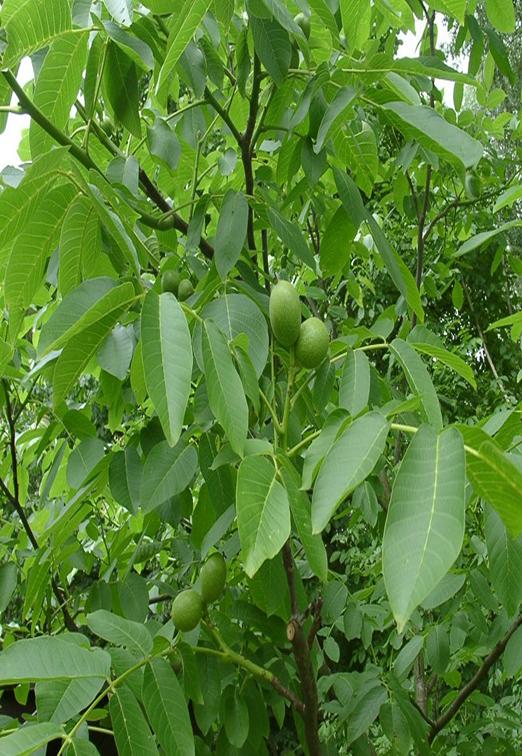
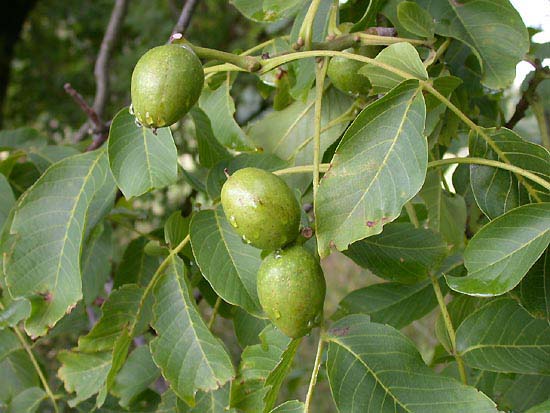
It is a fragrant medium free. External part of new branches are velvet like, Bark- 1.5 to S cuts, wide, grey having, longitudinal gaps. Inner part of the stalk is grey having black spots.
Leaves — compound, 15 to 30 cm. in length.
Leaflets— 5 to 11 or 7 to 9 in pairs. 7 to 20 cm in length and 5 to 10 ans. in breadth.
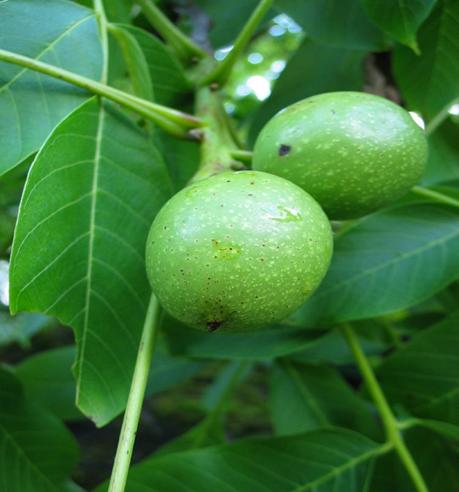
flowers — homosexual and 5,to 11 ans. in length. Fruits – circular with greenish striations on them and enclosed by tough covering. (To break a walnut them is a special nutcracker). It looks like a madanphala. It has a single seed with two layer. This part resembles the brain in structure. It is edible, Flowering season is spring and fruiting season in autumn.
Distribution & Habitat
In Himalaya about 1000 to 4000 m. height. In Kashmeer it grows plentifully.
Chemical constituents:
monoterpenes, sesquiterpenes, diterpene, eugenol, juglone
Properties:
Guns guru. snigdha.
Rasa : madhur:
Vipãka : madhur:
Virya ushna;
Karma –
Balya, rakta dosha hara, hridya, vistambi , rochanam
alterative, laxative, antiseptic, mild hypoglycaemic, anti-inflammatory, antiscrofula
Srotogamitva:
Dosha : Vataghna kaphapittavardhak
Dhatu. Majja (tonic, paralysis, dystrophy and gout); mansa: meda (brinhana): shukra (aphrodisiac).
Mala Purisha (snehan, laxative).
Indication:
Hridrogam, ksayam, kusta
herpes, eczema, Ulcers, wounds, fever, skin disease, cough, piles, leucorrhoea, mouth ulcers
Part used:
Leaves, bark, fruit
Dosage:
Leaf juice 10-15 ml
Powder 2-4 g
Decoction 50-100 ml
uses:
External uses : Local application gives a good complexion cures skin disorders reduces inflammation and pain and hence is used in vata disorders. Bark has haemostatic properly and its powder is used as a toothpowder which makes the gums strong. It is sold in Amritsar Swarna Mandir.
Internal uses : nervine tonic, therefore used In paralysis, brain impairments malnutrition. Being appetizer and mild laxative ii is used in ascites and constipation. Fried walnut is given in dry cough Pulp is useful In tuberculosis general debility and as an aphrodisiac