Botanical Name: Withania somnifera (Linn.) Dunal
Family: Solanaceae.
Introduction:
Asvagandha root juice is given as Nasya to achieve conception. Now a days scientists believe that the cultivated variety of withania have different than naturally occurring.
Names in different Indian languages
| English | Winter Cherry |
|---|---|
| Hindi | Asgandha, punir |
| Kannada | Viremaddinagaddi, kiremallinagida |
| Malayalam | Amukkuram |
| Sanskrit | Asvagandha, varahakarni |
| Tamil | Amukkira, amukkirakkilangu |
| Telugu | Vajigandha, pannirugadda, pulivendramu |
| Unani | Asgandh |
| Folk |
Synonyms
Hayagandhaa, Ashwakanda, Gandharvagandhaa, Turaga, Turagagandhaa, Turangagandhaa, Vaajigandhaa, Gokarnaa, Vrishaa, Varaahakarni, Varadaa, Balyaa, Vaajikari.
Withania ashwagandha Kaul (cultivated var.)
Withania somnifera (Linn.) Dunal (Chemotype I, II, III: Israele.)
Classification according to Charaka, Susrutha & Vagbhata
| Charaka | Brmhaniya, Madhuraskandha |
|---|---|
| Susrutha | |
| Vagbhata |
Varieties & adulterants – (CV – controversy, AD – adulterants)
1. W. somnifera
2. W. coagulans.
3. Nagori
4. WS-27-7 – cultivated
5.WS-23-55- cultivated
6.WS – 10 – 28- cultivated
Morphology
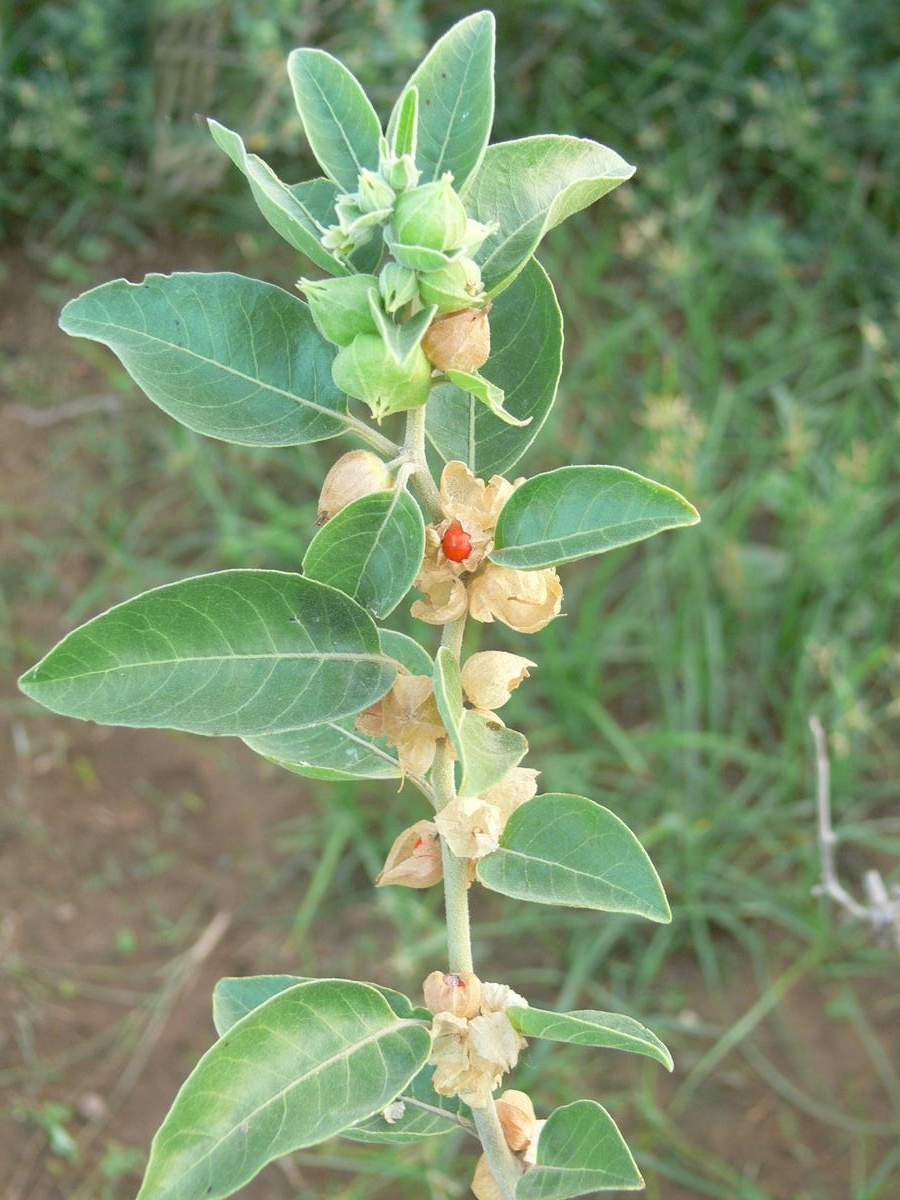
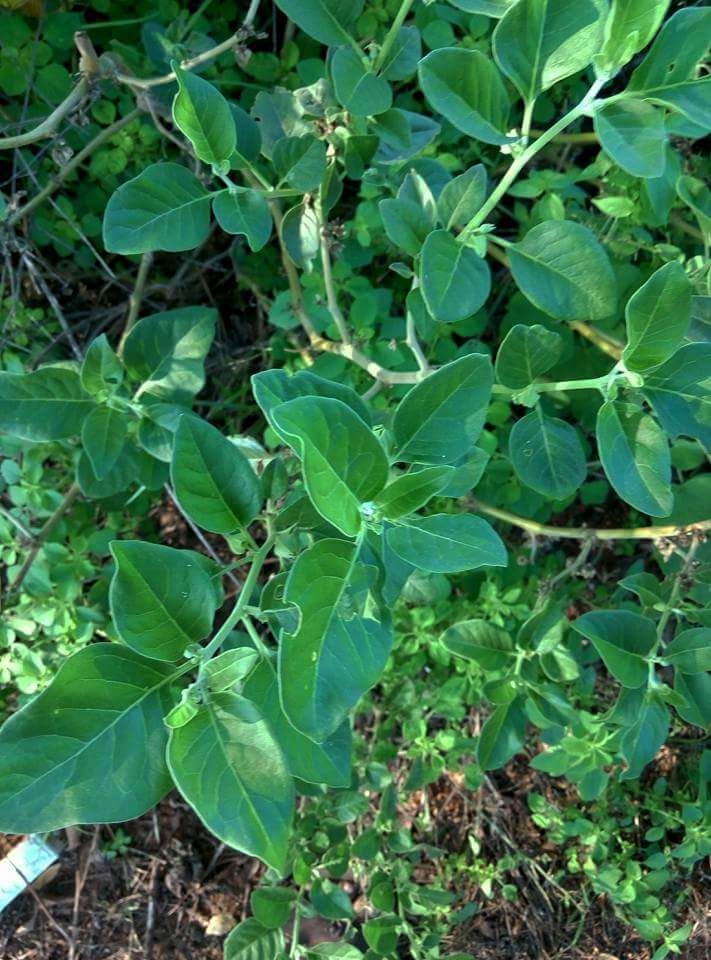
It is a under shrub, erect stem, 0.5-2 m high. Clothed with minute hairy tomentum.
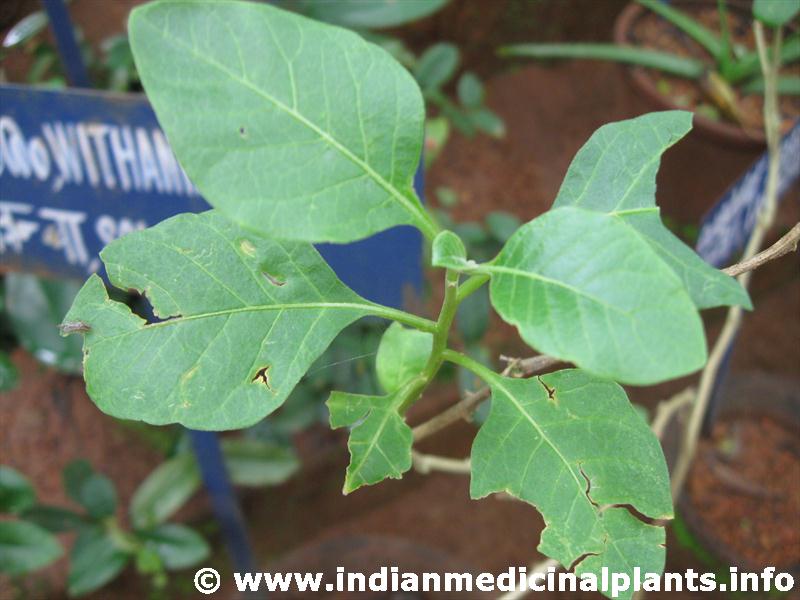
Leaves—simple, alternate, entire, ovate up to 10 cm long. subacute;
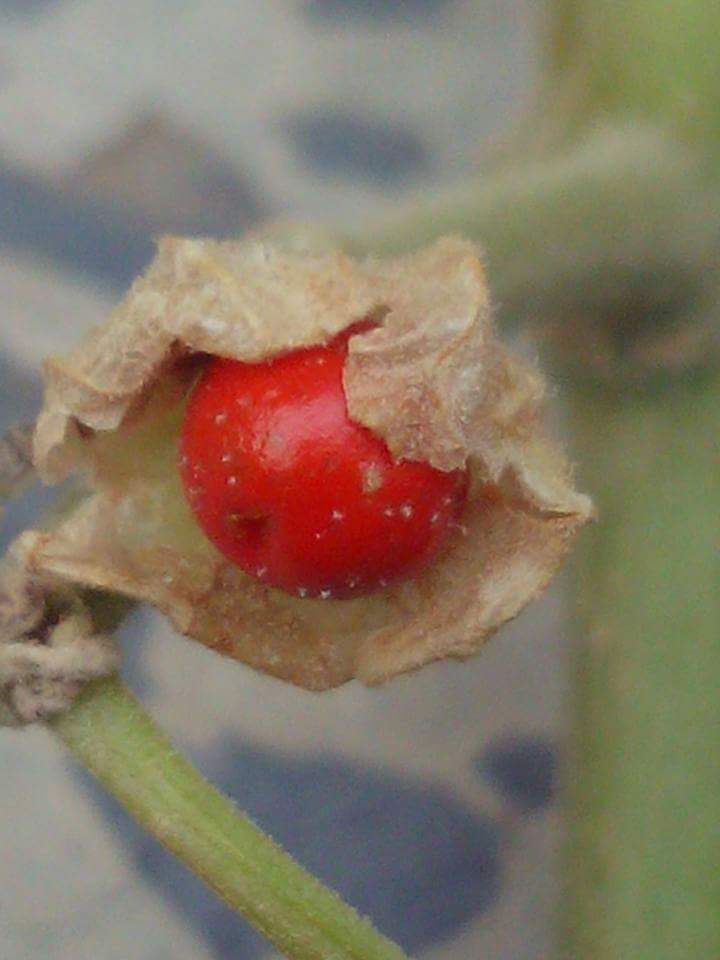
Flowers— axillary, sessile or shortly pedicled, fascicled or solitary, hermaphrodite; calyx campanulate, acutely 5-6-toothed, fruit-calyx inflated, larger than the berry; corolla campanulate, 3-6 lobed, short, greenish or lurid yellow; stamens attached at the base of corolla.
Fruits— berries, globose.
Seeds— many, discoid.
Distribution & Habitat
Cultivated, dry places.
Chemical constituents:
withananine, withananinine, pseudo-withanine, somnine, somniferine, somniferinine,Withaferin,withanone,somnirol,nicotine withanone, withanolide WS-1, withanolide A to Y; somnirol, somnitol; withasomniferin A, nicotine, preudotropine tropine, solasodifle, withasomnifle, sitoindosides VII-X, sominone, sominolide
Properties:
Rasa Katu,Tikta,kashaya
Guna Laghu, snighta
Virya Usna
Vipãka Katu
Karma Kapha-vãta hara,sukrakara, Rasayana,balya
anti-inflammatory, hepatoprotective,bantibacterial, sedative, hypnotic,diuretic, Antibacterial, antitumour, aphrodisiac
Srotogamitva:
Dosha : vatha hara
Dhatu :meda, sukra
Mala :mutrala
Organ : testis
Indication:
Sopha,svitra,ksaya, Jvara, Chardi, Kustha, Kandu, Krmi.,sonitha sukla
leucoderma, insomnia, nerve disorder, ulcer, constipation, insomnia
Part used:
Root, leaves
Dosage:
Leaf juice 10-15 ml
Powder 2-4 g
Decoction 50-100 ml
Internal uses:
External uses It reduces oedema and pain, that is why leaves or root paste is applied on enlarged cervical glands or swelling of other glands. In vata diseases and weakness, oil massage is done. The juice of ashwagandha leaves is used as eardrops in ear discharge.
Internal uses
Nervous system As it is a sedative and nervine tonic, it helps in atonic nerves, fainting, giddiness and insomnia.
Digestive system The bark powder is appetizer. carminative and anthelmintic and hence is used in abdominal pain, constipation and worms.
Circulatory system : It has an effect on the heart, purifies the blood and reduces oedema. So it is used for the weakness of heart, blood disorders and oedema. Its decoction is used in rheumatoid arthritis.
Respiratory system : It is an expectorant and has antiasthmatic property due to which it is useful in cough. Ashwagandha ash along with ghee and honey is effective in asthma, If phlegm is thin, it is used in the form of ash or its alkaline extract is used. Decoction of bark should be given in low dose for cough and asthma. It is also used as a tonic in the above conditions.
Reproductive system Ashwagandha is well known for its aphrodisiac property. It is used in semen disorders and leucorrhoea caused due to endometritis. A mixture of 5 g. of ashwagandha powder + 10 gms of ghee + 250 ml milk + sugar is a good tonic, nutritious and also aphrodisiac. It completely cures puerperal backache.
Urinary system It is diuretic and so used in oliguria or anurea. It is used to strengthen meda dhatu.
Skin It is used in vitiligo and other skin diseases, blisters heal when black ashes ‘of the roots are applied on them.
Important Yogas or Formations:
Ashwagandhadi churna, Ashwagandha rasayana, Ashwagandharishta, Askandpak, Maharasanadi, Sukumarghrut, Saubhagyasunthipak
Therapeutic Uses:
Root powder in honey useful in
(1) Vataja hrdroga
(2) Svasa
(3) Mutraghata
(4)Nidranasana
Descriptions on Ayurveda books / Nighandu:
1
2
3
4
5
6