Botanical Name: Solanum melongena Linn.
Family: Solanaceae
Names in different Indian languages
| English | Brinjal, egg plant |
|---|---|
| Hindi | Benkan |
| Kannada | Badanekaya |
| Malayalam | Valuthina |
| Sanskrit | Varthaki |
| Tamil | Kattirikai |
| Telugu | Vankaya, Niruvanga, mettavanga |
| Unani | Baingan |
| Folk |
Synonyms
Bhantaki, Bhantaa, Vaartaaka, Vaartaaku, Vaartaakini, Vrintaaka
Solanum ovigerum Dunal
Solanum trongum Poir.
Morphology
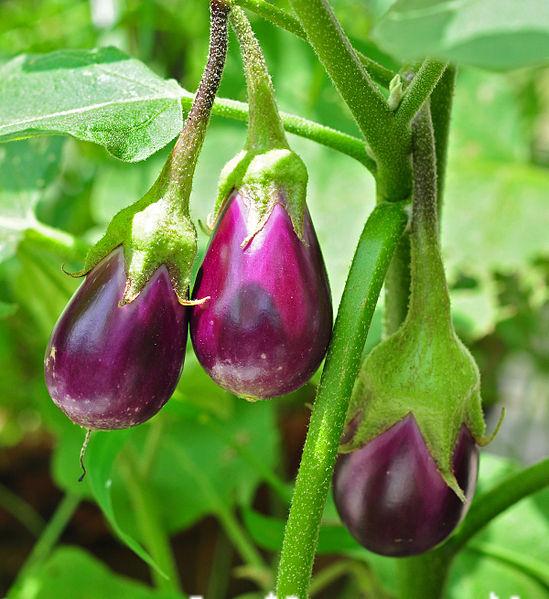
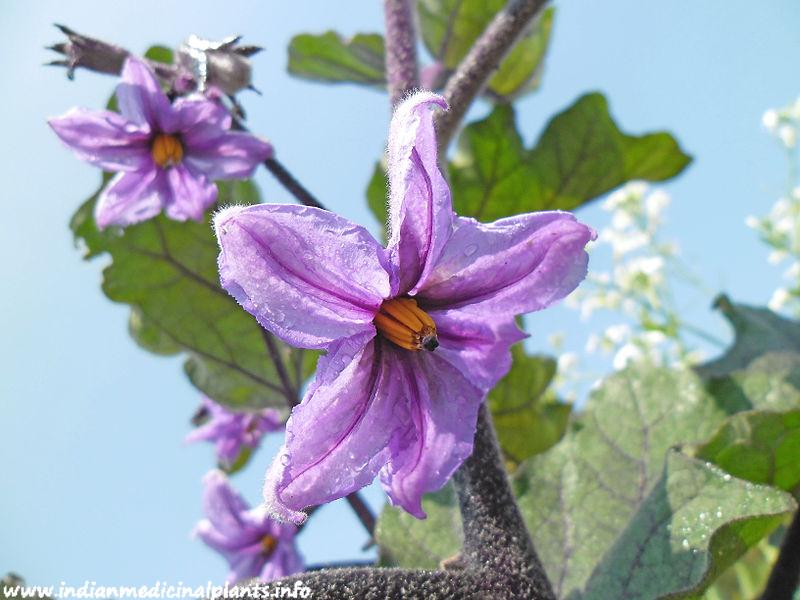
The eggplant is a delicate, tropical perennial often cultivated as a tender or half-hardy annual in temperate climates. The stem is often spiny. The flower is white to purple, with a five-lobed corolla and yellow stamens. The egg-shaped glossy purple fruit has white flesh with a meaty texture. The cut surface of the flesh rapidly turns brown when the fruit is cut open.
It grows 40 to 150 cm (1.3 to 4.9 ft) tall, with large, coarsely lobed leaves that are 10 to 20 cm (3.9 to 7.9 in) long and 5 to 10 cm (2.0 to 3.9 in) broad. Semi-wild types can grow much larger, to 225 cm (7.38 ft) with large leaves over 30 cm (12 in) long and 15 cm (5.9 in) broad. On wild plants, the fruit is less than 3 cm (1.2 in) in diameter, but much larger in cultivated forms: 30 cm (12 in) or more in length
uses:
liver complaints and for amenorrhoea. The fruit reduces blood cholesterol level
chemicals
Steroidal saponins, melongosides were isolated from seeds; tigogenin, diosgenin , Quercetin, 3-O-rhamnoside, kaempferol- 3-O-rutinoside