Botanical Name: Pueraria tuberosa DC.
Family: Papilionaceae; Fabaceae
Introduction:
Latin name : Pueraria = after Mr. M.M.N. Puerari – scientist; tuberosa = tuberous rooted
Most of people using Ipomea paniculata as Vidaari
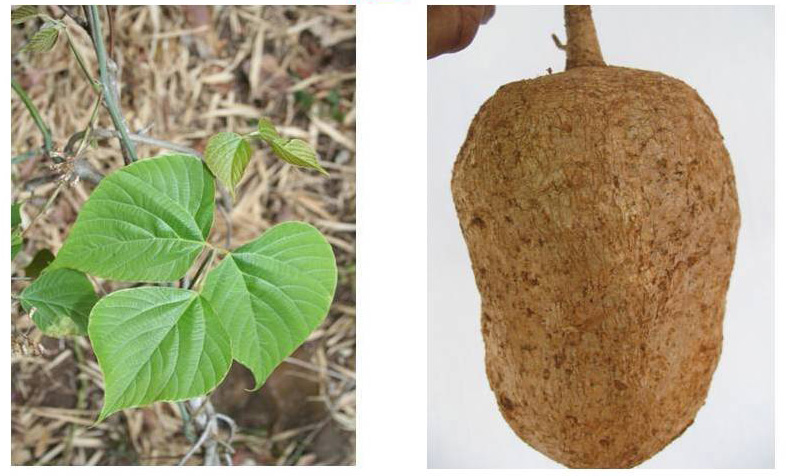
Names in different Indian languages
| English | Indian kudzu |
|---|---|
| Hindi | Vidarikand, sural |
| Kannada | Dari, biderakanda |
| Malayalam | Mutuku |
| Sanskrit | Vidaari |
| Tamil | |
| Telugu | Dar, gumodi |
| Unani | |
| Folk |
Synonyms
Vidaari, Swaadukandaa, Ikshugandhaa, Gajavaajipriyaa, Kandapalaasha, Bhuumikushmaanda.
Classification according to Charaka, Susrutha & Vagbhata
| Charaka | |
|---|---|
| Susrutha | |
| Vagbhata |
Varieties & adulterants – (CV – controversy, AD – adulterants)
Used as adulterant in Jivaka
Morphology
A wide spreading creeper, Its stalk has pores. Leaves – trifoliate, resembling the leaves of B. frondosa with 10-15 cms. long leaflets, pointed with dense hair on the lower surfac Inflorescence – purple.
Fruits – 6 to 9 cms. long. Tubers circular with a diameter of 30 to 40 cms. There is another variety called ksheervidari the tuber of which oozes out a thick latex on cutting it.
Distribution & Habitat
Throughout India
Chemical constituents:
Properties:
Guna : guru, snigdha;
Rasa: Madhura;
Virya : sheeta;
Vipaka:madhur
Karma –
Vrishya, rasayana, garbada, jeevaniya, brimhana
diuretic, cardiac tonic, galactagogue , liver tonic
Srotogamitva:
Dosha : Vataghna, pittaghna(cholagogue).
Dhatu: Rakta hemostatic. bleeding disorders.
hepatosplenomegaly(rasa (galactogogue. complexion enhancer). shukra (aphrodisiac). mansa – meda (brimhana). meda (demulcent).
Mala : Mutra (diuretic).
Indication:
Mutrakrichra,
Fever, joint pain, cough, constipation
Part used:
Rhizome
Dosage:
Powder 2-4 g
Uses : it is unctuous, anabolic, nutritive, cholagogue, carminative, cardiotonic, hemostatic, demulcent, aphrodisiac, galactogogue, diuretic, complexion enhancer and rejuvenator. Hence it is used to reduce intestinal dryness, in hepato-splenomegaiy, cardiac debility, bleeding disorders