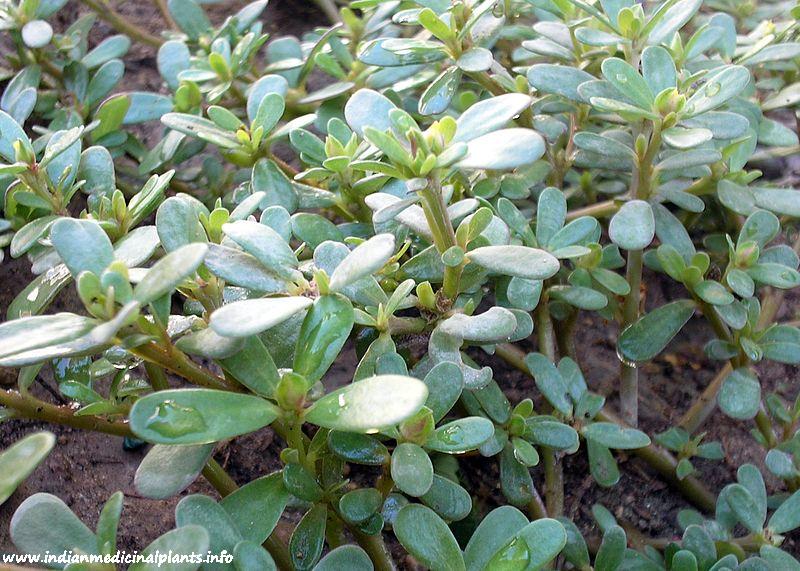
Botanical Name: Portulaca oleracea Linn.
Family: Portulacaceae
Names in different Indian languages
| English | Common purslane |
|---|---|
| Hindi | Badi noni |
| Kannada | Budagora |
| Malayalam | koluppa |
| Sanskrit | Gotika, brihat loni |
| Tamil | Karikkirai |
| Telugu | Pedapuvilakkuru |
| Unani | Khurfaa, Kulfaa |
| Folk |
Synonyms
Brihat Lonikaa, Lonaa, Loni, Ghoddhika, Ghotikaa, Upodika, Khursaa.
Morphology
It has smooth, reddish, mostly prostrate stems and alternate leaves clustered at stem joints and ends. The yellow flowers have five regular parts and are up to 6 millimetres (0.24 in) wide. Depending upon rainfall, the flowers appear at any time during the year. The flowers open singly at the center of the leaf cluster for only a few hours on sunny mornings. Seeds are formed in a tiny pod, which opens when the seeds are mature. Purslane has a taproot with fibrous secondary roots and is able to tolerate poor compacted soils and drought.
uses:
mild spasmodic, diuretic, antiscorbutic. Useful in scurvy , diseases of liver, spleen, kidney and bladder;