Botanical Name: Picrorhiza kurroa Royle ex Benth.
Family: Scrophulariaceae
Introduction:
It used for the treatment of Pãndu and Grahani mainly. it is an hepatoprotective agent.
Names in different Indian languages
| Hindi | Katuki |
|---|---|
| Telugu | Katuki |
| Tamil | Katukurohini, katurohini |
| English | Picrorrhiza |
| Punjabi | Kaundd |
| Punjabi | Kaundd |
| Marathi | Kali Katuki |
| Kanada | Katukurohini |
| Malayalam | Katukurohini |
| Sanskrit | Katurohini, Kattarohini, |
| Unani | Kutki, Kharbaq-e-Hindi. |
Synonyms
Katukaa, Katuki, Katukikaa, Krishnabhedaa, Kaandaruhaa, Matsyashakalaa, Chakraangi, Shatparvaa, Arishta, Ashokarohinya, Shakuldaani.
Classification according to Charaka, Susrutha & Vagbhata
| Charaka | Bhedaniya, Lekhaniya, Stanyasodhana Tiktä skandha |
|---|---|
| Susrutha | Patolyadi Pippalydi, Mustãdi |
| Vagbhata | Patolyadi, Mustadi (A.H.) Pippalydi (A.S.) |
Varieties & adulterants – (CV – controversy, AD – adulterants)
1. Katuka rohini (P. Kurroa)
2. Asoka rohini (E. paniculata).
3. Physalis minima -[CV]
4. Cardiospermum helicacabum -[CV]
5. Picrorhiza scrophulariaeflora Pennell.
Morphology
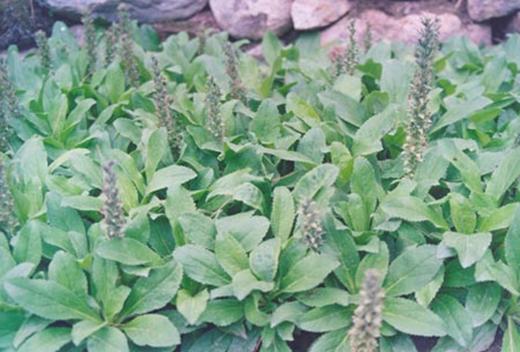
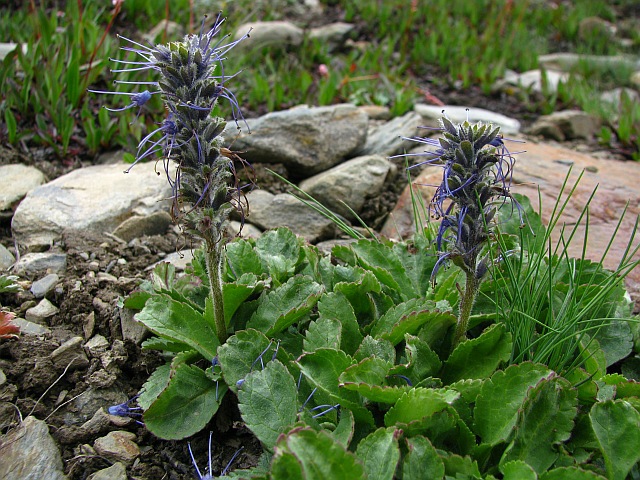
A hairy herb with perennial bitter rootstock.
Leaves— subradical, spathulate, serrate.
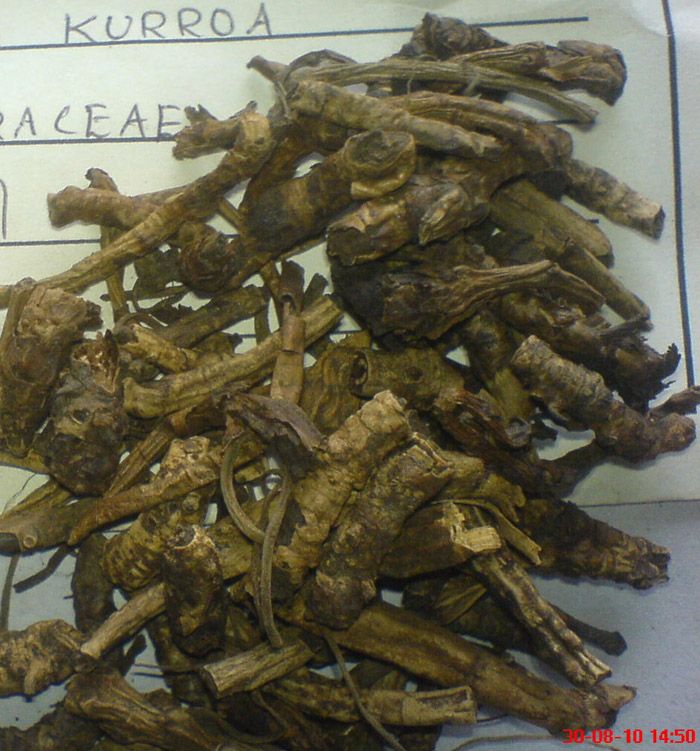
Rhizome : it is dried, cylindrical, deep grayish brown in color and longitudinally wrinkled with annulations at the tip.
Flowers— in many-flowered skiper. Flowering branch longer than the leaves.
Fruits— Ovoid, capsules. Flowering and fruiting occur between October-December.
Habitat & Distribution : Grows in the Himalayas from Kashmir to Skim at the height of 2000- 4500 m.
Chemical composition : Roots contain picrorrhizin (a bitter ingredient) 15%. cathartic acid 9%, also glucose, wax etc D-mannitol, Kutkiol, Kutkisterol, apocyanin; phenol glucosides; androsim and picein iridoid glycosides; kutkin, picroside I, II & Ill; Kutkoside, minecosil picrorhizin, arvenin III etc.
Properties—
Rasa Tikta
Guna Rüksa, Laghu
Virya sita
Vipãka Katu
Karma Kapha-pittahara, Bhedana, Lekhana, Dipana, Hrdya
Laxative, carminative, digestive, anthelmintic, anti inflammatory, depurative, cardiotonic, expectorant
Indications— Jvara, Prameha, svãsa, Kãsa, Rakta vikãra, Dãha, Kustha, Krmi, Arocaka, Visama Jvara, stanya dosha
colic, anorexia, cough, fever, intermittent fever, diabetes, jaundice, haemorrhoids, hepatitis, chronic dysentery, amoebiasis
Part Used— Root, underground stem (Rhizome & roots)
Dosage— Powder 0.5-1 g (therapeutic) and 3-6 g (purgative)
Internal uses
Digestive system : Bitter to taste, if given in small close it stimulates taste buds and increases appetite, liver stimulant and cholagogue. In excess amount acts as a purgative. It is also anthelmintic. In small doses it is useful in conditions like loss of appetite, liver disorders and jaundice which are due to obstruction in biliary passages. In constipation, flatulence and ascites, it acts as a purgative if given in large dose. When given in congestive cardiac failure it causes a watery diarrhoea. This reduces the circulatory hydrostatic pressure on the heart and thereby the workload on it. It is an appetizer, purgative and vermifuge and hence is useful in abdominal diseases
Circulatory system : It is pittavahasrotogami and raktavahasrotogami. It reduce heart rate and palpitations. It increases the heart strength and blood pressure. By purifying blood it reduces inflammation. It reduces pulse rate which is similar to the action of digitalis. In head disease kutaki and glycyrrhiza in equal quality with sugar, is prescribed. It is used in jaundice and anaemia. Respiratory system : As it acts on the rakta dhatu, it reduces pulmonary disorders. Being an expectorant, it alleviates cough and dyspnoea.
Urinary system : It acts as a diuretic in diabetes.
Skin It reduces burning and pruritos induced by improper secretion and excretion of bile. It reduces kapha and pitta dosha in blood. It is used in many skin disorders.
Temperature : Useful in fever, pittashodhan and increases flow of bile, reduces burning in fever. malarial fever are suppressed with kutaki shodhan in 3 gm. dose.
Adulteration Bitter plants and sometimes roots of coconut are used.
Satmikaran– : Rasayani in small dose, acts as scrapin (lekhan) in large dose. It is a boon to physician by this dual action.
Important Yogas or Formations
Arogyavardhani (50% katuki), Katukadyavaleha, Tiktadiquath, Arogyavardhini Tiktãdya ghrta, Katukãdya ghrta.
Important research work going on
(1) Hepato protective activity
(2) hepatotoxicity
(3) laxative activities
(4)hydrocholeretic
(5)diuretic activity
(6) antibacterial activity
(7) bronchial asthma
(8) Anti-inflammatory activity
Therapeutic Uses—
(1) Hridroga— Katukã and Madhuka are taken with sugar water in Pittaja Hrdroga (C.Ci 26 & A.H.Ci. 6).
(2) Pandu— Katuka, sugar and Dronapuspi juice as Anjana (S.B.M.).
(3) Kustha— Katukã, Ativisã, Usira, and Candana are collectively given for internal usage (C.S.Ci. 7).