Botanical Name: Ougeinia dalbergioides Benth.
Family: Papilionaceae; Fabaceae
Introduction:
Latin name : Ougeinia = the palace of Ujjain was constructed from the timber of this tree: dalbergioides = after Nicholas Dalberg, a Sweedish Botanist who lived for 110 years (from1720 t0 1830 A. D.)
Names in different Indian languages
| English | Chariot tree, Punjab Kino, sandan |
|---|---|
| Hindi | Sandan, tinnas |
| Kannada | Karimutale |
| Malayalam | Totukara, malavenna |
| Sanskrit | Tinisha, Syandana |
| Tamil | Narivengai |
| Telugu | Tellamotuku |
| Unani | |
| Folk |
Synonyms
Tinishaa, Tinisha, Syandana, Nemi, Sarvasaara, Ashmagarbhaka, Vajjala, Chitrakrt
Ougeinia oojeinensis (Roxb.) Hochr
Classification according to Charaka, Susrutha & Vagbhata
| Charaka | |
|---|---|
| Susrutha | |
| Vagbhata |
Varieties & adulterants – (CV – controversy, AD – adulterants)
Morphology
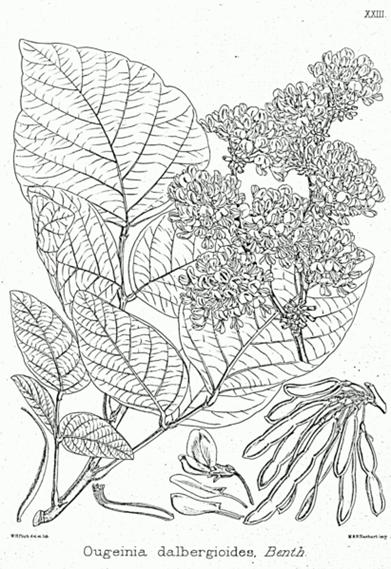
This tree grows up to a height of 7 to 15 mtrs. Bark is whitish, reddish or blackish in colour. On piercing the trunk, a red and granular gum oozes out.
The leaves and leaflets resemble those of palash. The last leaf is very big.
Flowers are reddish, pink and in bunches. Legumes resemble ground nut containing 2-3 seeds,
Distribution & Habitat
Outer Himalayas
Chemical constituents:
dalbergion, hemoferritin, urgenin, quercetin, kaempferol
Properties:
Guna : laghu, ruksha;
Rasa : kashaya;
Virya : sheeta;
Vipaka: madhur
Karma –
Vranahara, raktadosha hara
carminative, digestive, astingent, cooling, diuretic,
Srotogamitva:
Dosha : Kaphaghna, pittagbna. Dhatu : Meda, rakta, raktameda.
Mala : Purisha (diarrhoea. dysentery), mutra (antidiabetic)
Indication:
Pandu, vrana, daha, switrakushta, krimi
Ulcers, wounds, fever, skin disease, cough
Part used:
Whole plant
Dosage:
Leaf juice 10-15 ml
Powder 2-4 g
Decoction 50-100 ml
uses:
Bark and gum are astringent, hemostatic, antidiuretic, antidermatoses and rejuvenating. Therefore they are useful in oedema, leucoderma and other skin diseases. Internally, it is used in diarrhoea, dysentery, blood disorders, diabetes, skin diseases, debility etc.