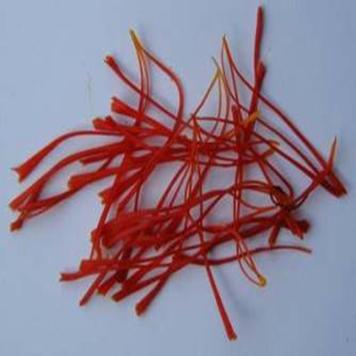
KUMKUM - Crocus sativus
|
KUMKUM Crocus sativus
Family :Iridaceae Latin name : Crocus = name adopted from Theophratus; sativus = cultivated. Scientific classification: Crocuses belong to the family Iridaceae. The saffron crocus is classified as Crocus sativus and the autumnal species with flowers of a more delicate shade of lilac as Crocus speciosus. The yellow cloth-of-gold crocus is classified as Crocus susianus, the Dutch crocus as Crocus moesiacus, and the early crocus as Crocus imperati.
English name : Saffron (it is obtained from anthers of two spp)
Sanskrit names : Ghusrun, Rakta, Kashmir, Balhik, Kesar, Kashmiraj, Kumkum, Agneeshekhar, Asrugvar, Shatha, Shonit, Pitaka, Rudhir,
Botanical Description : It is a shrub. Leaves are seen towards the base of the stem and are compactly arranged, flowers - either 2 to 3 flowers are in a bunch or one solitary flower is found besides each leaf, flowers are violet in colour. On every flower, there are 3 yellow coloured stamens. Seeds - the ovary is trilobed and in each lobe many round seeds are found. The stalk of gynaecium is made up of three fibers and each fiber has a red coloured stigma. This is known as kesar. Each flower yields three fibres of kesar and twenty flowers yields 120 mg. kesar. The plant flowers in autumn.
Habitat: it is basically an Asian plant but now it is grown in Spain, Iran and Kashmir.
Chemical composition : It contains a dye, volatile oil 8 to 13.4 %, crocin and picrococin. (Kashmiri kesar is brown, thin, smells like lotus and has a colour similar to that of the rising sun. It is considered to be the best, Balhikaj kesar is thin, whitish and smells like kevada. It is of moderate quality. Parasdeshaj kesar is thick, whitish and smells like honey, It is of inferior quality.)
External uses : It improves complexion and hence is used for application on hyper pigmented lesions of the skin. It is also used for apply in headache. Its paste is applied on wounds. For weak eye sight, a mixture of rosewater and kesar is put in the eyes. Its paste is also used in hepatitis. It is useful in nervous debility, migraine, rheumatoid arthritis, pain caused by vata, loss of appetite. liver disorders, heart diseases and blood disorders, Kesar is used in dysuria. It is also useful in impotency, dysmenorrhoea, amenorrhoea and painful labour, It is very useful in small pox. It has also been used as a rejuvenator since ancient, times. (According to Shri Priyavrat Sharma, this plant survives for many years. But my opinion is that it is a very small shrub living for about 1-2 years. I have seen it grown in Kashmir. It hardly achieves a height of 10 to 15 cms. from the ground)
Srotogamitva Dosha : Tridosha and kaphavataghna. Dhatu : Rakta (improves complexion. useful in hyperpigthented spots, liver, blood and heart diseases and small pox), majja (debility), shukra (impotency). rasa (dysmenorrhoea, amenorrhoea). Mala : Mutra (useful in dysuria).
Crocus Crocus, genus of hardy perennial plants, of the iris family, native to southern Europe and Asia and widely cultivated. Crocuses produce a single tubular flower and grasslike leaves growing from a corm, or underground stem base. Common autumnal species include the saffron crocus, which has a bright lilac flower from which the dye and flavoring agent saffron is made, and a crocus whose flowers are a more delicate shade of lilac. The yellow cloth-of-gold crocus is one of the earliest blooming flowers in temperate climates. Other spring species are the Dutch crocus, which is also yellow, and the early crocus with lilac or white flowers.
|
|
|
|
|