Morphology
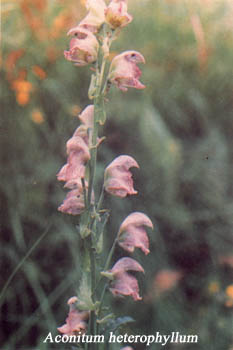
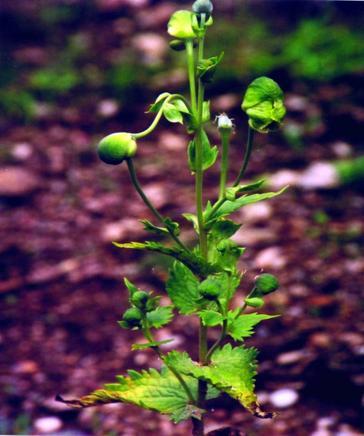
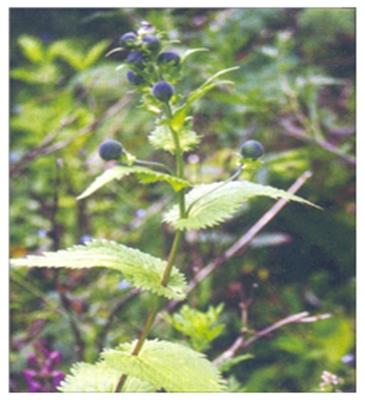
(i) A. heterophyllum—
Roots biennial, paired, tuberous; whitish or grey. Stem erect,
simple or branched, from 15-20 cm high. glabrous below, finely crispo-pubescent
in the upper part.
Leaves heteromorphous, glabrous: lowest on long petioles (13cm);
blade orbicular- cordate or ovate-cordate in outline with a usually narrow sinus
(1-1.5 cm deep); usually 5- lobed to the middle, amplexicaul.
Inflorescence slender raceme or a lax, leafy panicle,
crispo-pubescent; Sepals bluish or violet (rarely whitish); navicular obliquely
erect, shortly or obscurely beaked, 18-20 mm high, 8-9 mm wide. Carpels 5,
elliptic-oblong. Follicles contagious, linear-oblong, straight, 16-18 mm long.
Seeds pyramidal, 3-4 mm long, blackish brown.
Distribution— commonly found in sub-alpine and alpine zones
Himalayas from Indus to Kumaon at 2000-5000 m (6000-16000 ft.).
(ii) A.
palmatum—
Roots, biennial, paired, tuberous; conical or cylindrical 4-10
cm long, 0.75-3 cm thick.
Stem erect.
Leaves scattered, upto 10, the lowest usually withered at the
time of flowering, glabrous, or the upper most finely pubescent on the nerves
below; petiole slender 4-10 cm long; blade orbicular-cordate to reniform ,
3-lobed.
Inflorescence a very loose, leafy panicle or raceme, 10-20 cm
long. Sepals bluish or variegated white and blue, uppermost helmet-shaped.
Carpels 5, sub contagious in the flower.
Follicles sub contagious or some what diverging in the upper
part, oblong, obliquely truncate, 2.5-3 cm long and 5-6 mm broad.
Seeds blackish, ovoid, about 3 mm long, round in Cross section.
Chemical Constituents—
(i) A. heterophyllum—
Atidine , hetisine, heteratisine ,Diterpene alkaloids ,
heterophylline, heterophylline ,heterophyllidine heterophyllisine, hetidine,
atidine & ,Atisenol, a new entatisene diterpenoid lactone from roots.
F-dishydrçatisine, hetidine, hetisinone, heteratisine, hetisine,
benzylleteratisine, beta —sitosterol, carotene and 3— isoatisine from rhizomes
(ii) A. palmatum—
non-toxic alkaloid has been isolated from A. palmatum
Distribution & Habitat
Maharashtra &
Himalayas
Properties
Rasa - Katu, Tikta
Guna -Laghu, Ruksha
Virya -Ushna
Vipaka -Katu
Karma - Dipana, Pacana, Grahi, Tridosahara, otha hara, Viaghna, Krmihara,
Aroghna, Jvara hara, Kasa hara
Prabhava- Visa hara

External uses
The crushed eaves,
mixed with saindhav are applied focally. The seeds crushed in honey are applied
locally on throat, in tonsillitis. Nasal insufflations of roots is beneficial in
headache (especially migraine).
Internal uses
Respiratory system : The
juice of roots along with milk is an expectorant Root powder is given orally in
cervical lymphadenitis.
Digestive system : Seed
and root are used in ascites. Seeds are laxative.
Urinary system : The
seeds are diuretic, the root decoction reduces burning of urinary tract. It
increases volume of urine,
Reproductive system :
Root is used in sperrnatorrhoea. The decoction of roots is also used in burning
of vagina.
Circulatory system : The
juice of leaves along with juice of zingier reduce perspiration.
Toxic effects—
Over dosage (More than
5-6g)
produces symptoms like dryness of
mouth, tremors etc.
Pretreatment of A. palmatum root in cow’s milk and urine reduced
the cardio-toxicity (Singh L.B. et al., 1985).
Srotogamitva:
Dosha : Tridoshaghna.
Dhatu
: Majja (brain tonic), rakta. shukra.
meda:
Mala
: Mutra (diuretic). purisha
(laxative). sweda.
Part Used—
The tuberous root is medicinally used both alone and in combination.
Yogaratnakara mentioned that Haritaki may be used as the substitute for Ativisa.
Dosage—
Root powder l-3g per day (divided doses)
Indications—
Atisara, Jwara, Kasa, Bala röga. Visa röga, Ama dosa, Chardi, Krimi roga,
Agnimandya, Rakta pitta, Yakrd roga, Trsna, Pinasa, Ara, Pittodara etc.
Important
research work going on
1. contractions of frog rectus abdominis induced by acetylcholine.
Clinical Studies
2. diarrhoeal disorders
3. hypolipidemic effect
Therapcutic Uses—
(1) Bala röga—
Ativisa alone or along with
Karkaangi
and Pippali in case of cough and fever (A.H.Ut.2/57
&
V.M.66/10)’.
(2) Atisara— Ativisa + Bhanga + Vaca as powder
(3) Jvaratisara— sunthi, Kutaja, Musta, guduçi & Ativisa are
given orally in the form of decoction .
(4) Grahani— The decoction made of Ativia, sunthi
&
Musta is administered orally to
destroy the Ama (C.S.Ci.15/98)3.
(5) Mutra
krçchra— Ativisa, Amla
dravyas, Sunthi, Goksura, Kantakari are made as Peya (gruel) and given along
with Phanita (jaggery syrup)- (C.S.Su. 2/22).
(6)
Visa roga— A ghee
prepared with Ativisa and cow’s milk
is used orally or as nasal drops in case of acute poisoning. The ghee may also
be processed with Sveta and Madayantika (S.S.Ka.1/64)
(7) Musika
Visa— Ativisa root is made into paste
by grinding with honey and administered orally (S.S.Ka. 7/39)’.
(8) Vrana— syonaka
, Prativisa, Kantakari müla are made into paste and applied over the wounds
(A.H. Ut.
35/47)2.
(9) Kuksi roga /Udara rogas- 1 part Ativisa + 3 parts Añkola,
administered orally with rice water (Tandulodaka)